Take Wing Tips: Preparing your Pattern Pieces

opener

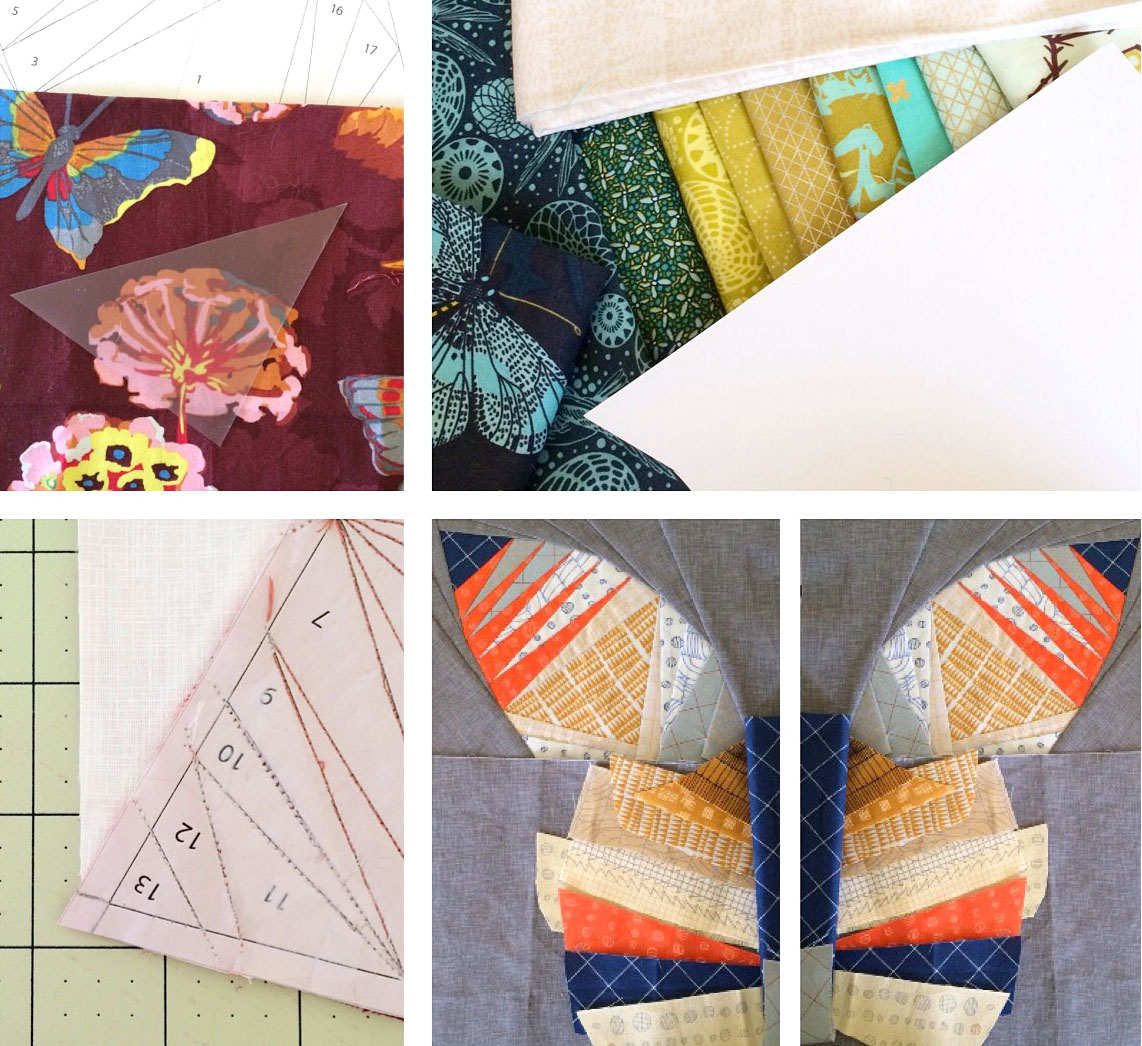
This week I’m going to be talking about tips and tricks for planning, starting, and assembling your Take Wing butterfly! Today I’ll be covering the preparation of your pattern pieces including a couple paper piecing tips that I use and love. Tomorrow I will cover planning, layout and fabric selection (which will probably be a really long post!) and then a few assembly tips and finishing options.

Many people use basic printer paper for paper piecing, and it works totally fine! I prefer to use Carol Doaks Foundation Paper. It is inkjet and laser printer friendly and really thin, so it’s easy to sew through and easy to remove. The biggest benefit in using it in a project like this is when it comes to piecing together the sections. Some areas have a lot of bulk along the seam, and thinner paper makes sewing them together much smoother! Alternatively, you can remove the paper from the seam areas before sewing the sections together.

Many paper piecing patterns are small and do not require the piecing together of pattern pieces. I touch on this in the pattern directions a bit, but still get a lot of questions about it, so here’s a little bit more detail on the subject.

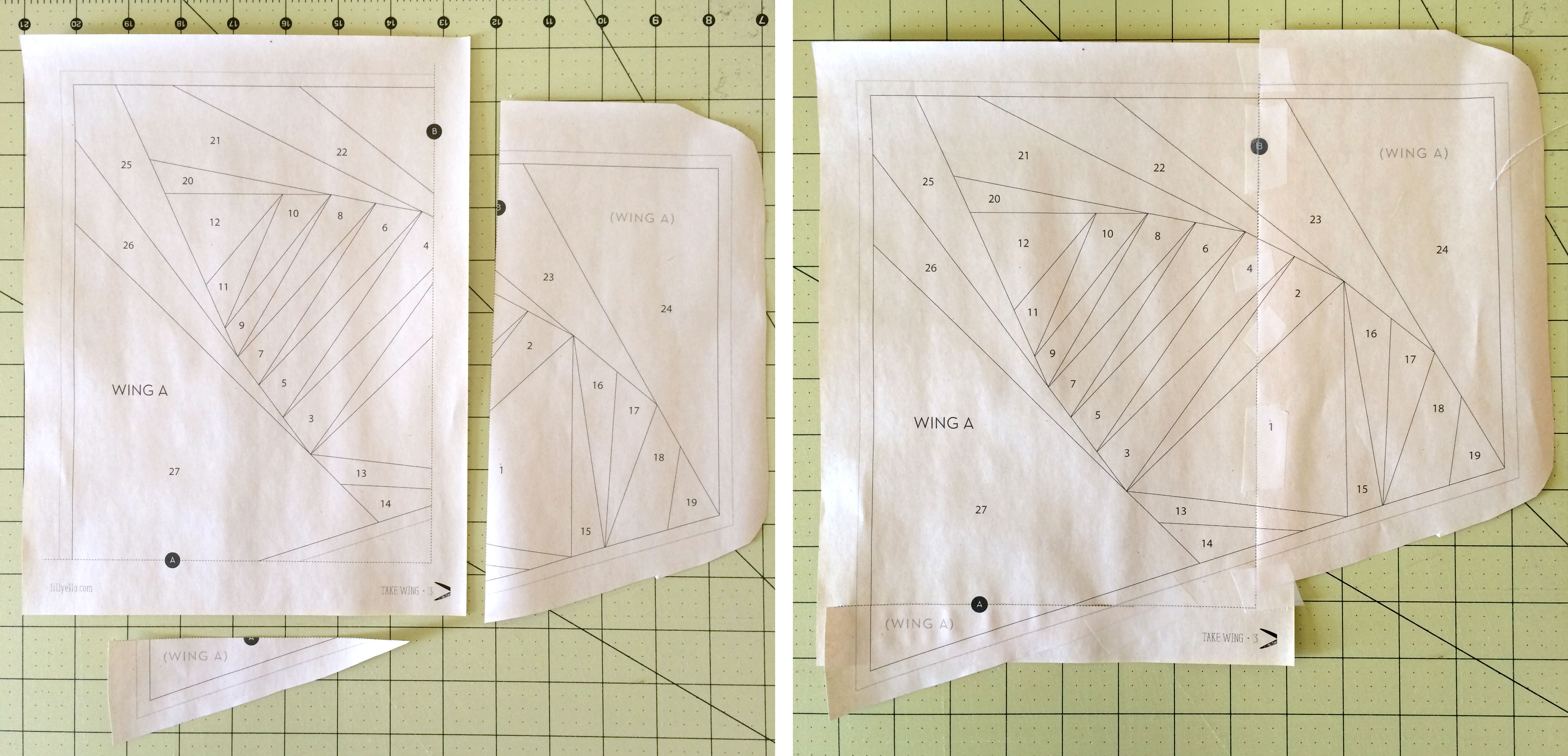
You can use a glue stick or tape to connect your pieces, and it’s really a matter of personal preference. Regardless of which method you choose to use, after printing out your pattern pieces, be sure to leave one from each section uncut. We’ll refer to Wing A for example here.
blog - pieces 1

Wing A has three sections. I leave the largest section uncut and then I cut along the dotted line of the two smaller sections. Then you will lay them on top of the uncut piece, lining up the cut edge with the uncut dotted lines, and glue or tape.

The advantage to using glue is that you are not sewing through tape! The disadvantage to glue is that sometimes it comes loose and it can also cause a little bit of rippling in your paper.

The advantage of tape is that it is easy and sticks together well. The disadvantage is sewing through tape OR possibly ironing over tape, which is a mess, trust me. That being said, I often use tape. I just try to tape inside large areas and not cross over any sewing lines. I also tape on the back side along the loose edge from the overlap of the uncut piece, but you have to be extra careful to not iron over the tape.

Once your pieces are together, you can then roughly trim the entire piece down outside of the outer seam line. Do not cut the paper pattern to the outer seam line, as you’ll want that for trimming your sections later.

blog - pattern trace

The next step I recommend is tracing the pattern lines onto the back side of the pattern pieces. This step is not necessary, but even as an experienced paper piecer, I find it extremely helpful and worth the little bit of time it takes. You can use a window, your computer screen or a lightbox, if you have one. The tracing doesn’t have to be perfect, as it’s just a reference.

Doing this allows you to easily cut your fabric, double check your work, adjust placement on fussy cuts and check the size of your pieces as you sew. All these things mean less time with your seam ripper!

blog - lines check

Stop back in tomorrow when I’ll be talking way too much about inspiration, layout, fabric selection, fussy cutting and more – see ya then!
blog - end


Take Wing Pattern now available!

blog main

Happy Monday, all! I’m so excited to say that my Take Wing pattern is now available for instant download. Are you excited? Or am I just a nerd? I’ve put many hours and lots of love into creating this pattern and I hope you enjoy sewing it as much as I did! (or I should probably say do, because I’ve currently got three more in the works.)

Click here to purchase an instant download PDF from my Payhip shop
(it is international and VAT tax friendly, wahoo!)

You can also purchase the pattern from my Etsy shop here, but because of the VAT tax laws, the PDF will not be an instant download, but will be emailed to you after purchase.

This pattern is for the intermediate sewist with paper piecing experience and the finished size is 24″ x 15″. Ultimately, there isn’t anything too complicated about the piecing or the assembly, but there is a lot of pieces to manage and some angled seams to sew together. That being said, an advanced beginner could probably take on this project as well.

For those who are new to paper piecing, I’m working on a mini Take Wing that will be smaller, simpler, and include full foundation paper piecing directions. It can stand alone but will also include directions on how to combine it with the original for even more fabulous quilt, so stay tuned for that!

I’ll also be posting lots of photos and helpful tips here and on my instagram and facebook pages, so be sure to follow me or check the hashtag #takewingpattern for these and more inspiration from others creating the pattern.

Speaking of inspiration, I’ll wrap this up with a little to get your creative juices flowing! Here are three versions created by my testers, aren’t they amazing?

becca final edit

They really showcase the wide fabric and color possibilities you have with this pattern. The above was created by Becca Cleaver (@cleaverr). The constellations in the background are just amazing!

charlie final

This one was created by Charlie Dunn (@travelingcharlie79). She added a border to the pattern and I love the way it really makes the colors pop.

alissa final

This one was created by Alissa Lapinsky (@alissalapinsky). The splashes of red and chartreuse are so beautiful and the texty background is one of my favorite prints.

And here are some of my colorings for versions I’m working on. As soon as I get a couple more minis made up, I plan to make a quilt with nine butterflies. Honestly though, planning the colors and fabrics for that is kind of making my head spin!

place pink orange

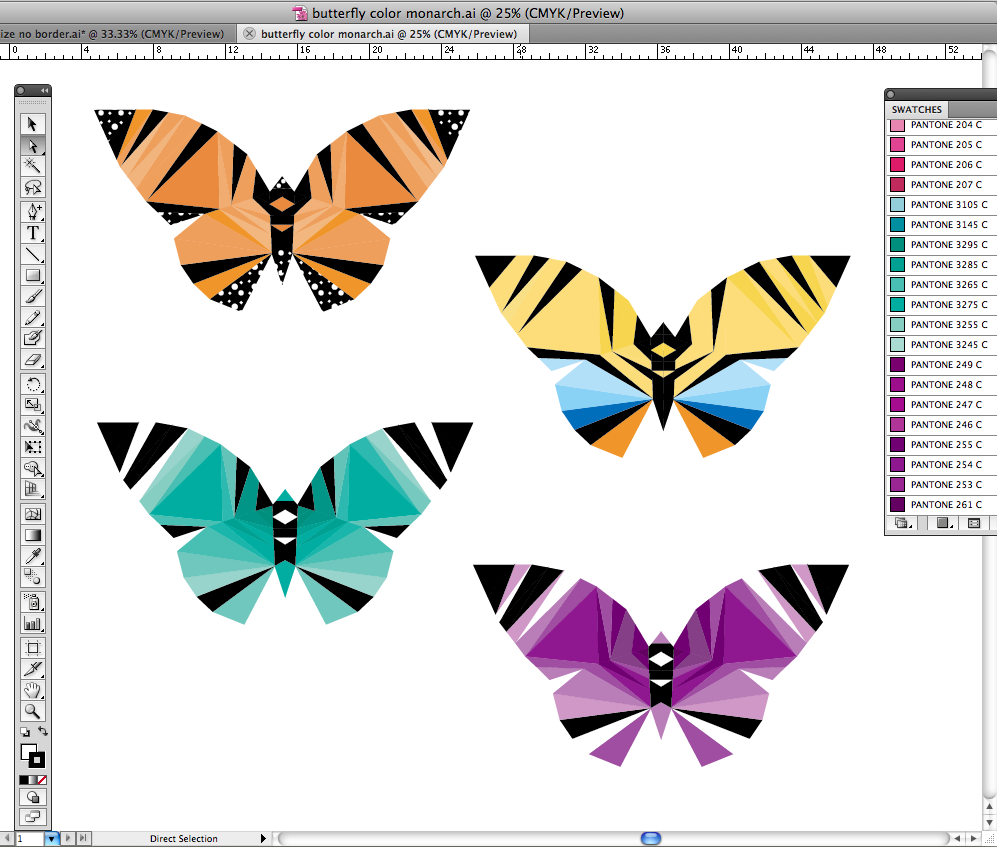
The above shows one color palette, six ways. Which is your favorite? Below you’ll see my version of a monarch, a swallowtail and two monochrome options.

Screen shot 2015-03-09 at 7.59.50 AM

If you have any questions about the pattern or need any help along the way, please don’t hesitate to contact me through my site here or DM me on instagram or facebook. I can’t wait to see all your creations!

take wing on shed edit

EPP Table Topper Pattern

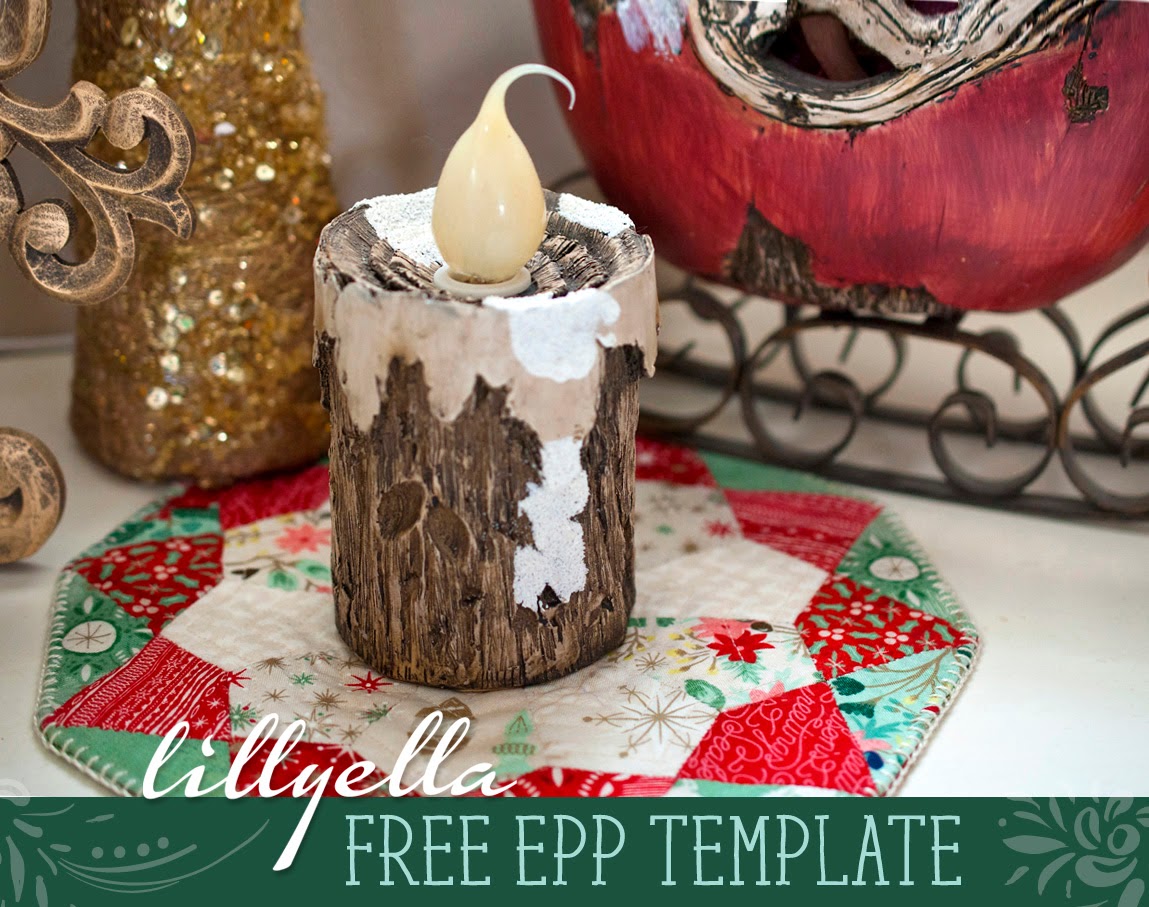
Free EPP Table Topper Template | lillyella stitchery
This pattern, or something like it, may very well exist somewhere in the world. But with my 25th & Pine charm pack in hand, I went searching for a small EPP pattern that would be relatively quick and had no luck, so I just drew one up.
I am by no means an english paper piecing expert and everyone has their favorite methods, so I’m just sharing my pattern templates here rather than a full tutorial. I will, however, provide some links to other tutorials for anyone who is new to EPP and explain how I finished my piece. The great thing about it is that all you need is fabric, a needle and thread – no sewing machine or experience is necessary.
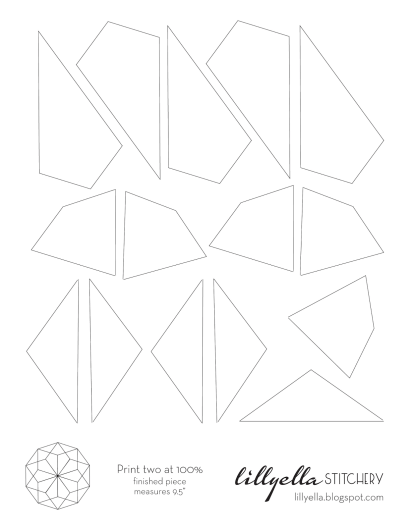
This pattern creates a piece that is 9.5″ wide and is designed to be charm square friendly (5″ fabric squares). You can get two center kite pieces from one charm square and more of the smaller pieces, but I used 5 white, 5 red and 5 green charms to create my piece. This pattern is also great for scraps, the biggest piece you need is about 2.5 x 5, but the templates can also be printed larger or smaller to create a different sized finished piece.
Free EPP Table Topper Template | lillyella stitchery
I made mine into a little table topper (isn’t it the perfect little mini tree skirt?!), but it would also be nice used on a pillow, as a trivet or on a bag. You can download a PDF of the templates by clicking the image below. You will need to print two sheets so you have ten of each shape.
I thread basted my pieces because I just haven’t gotten the swing of the whole glue basting thing yet, but that would certainly work, too. When sewing my pieces together, I followed the order shown below.
To finish my piece I removed the papers and cut a piece of batting to the exact size of my piece (you could also use insulbrite if you wanted to make a hot pad). I then unfolded the outer edges of the green pieces and pressed it well. I layered the piece and the batting and did some machine quilting on the center, but you could also do hand quilting or spray baste the batting in place and quilt after attaching the backing. I only wanted my quilting to show from the top.
I cut a piece of backing fabric slightly larger than my piece and placed the quilted top and back right sides together. I sewed around the outer edge, using the pieced top as a guide, with a 1/4 seam and left a couple inches open for turning. I trimmed the seam, turned the piece right side out and pressed. You could machine or hand quilt at this point if you wanted to see it from both sides.
Free EPP Table Topper Template | lillyella stitchery
I decided to finish my piece with a blanket stitch around the edge using a DMC pearl cotton and I love the way it came out. This also closed up the area I left open for turning. And voila! All done.
Here are some tutorials on english paper piecing:
Craftsy – English Paper Piecing from Beginning to End
All People Quilt – English Paper Piecing
Flossie Tea Cakes – EPP, where to begin
YouTube video – How to Finish an EPP Project
And you can find a good tutorial on how to do a blanket stitch here.
Free EPP Table Topper Template | lillyella stitchery
I hope you enjoy the template! If you have any questions, feel free to leave a comment below or send me an email anytime.
Free EPP Table Topper Template | lillyella stitchery