Flex Frame Pouch & Write On Patterns

website main

A couple weeks ago I shared my Flex Frame Pouch pattern on fabric.com during their Passport to Summer series for a back to school project. Some of you may recognize this from Make Modern Magazine and the Swapaholics Retreat, and now you can download the free pattern, too. Flex frames are an awesome alternative to zippers and are super easy to use! You can find the 3.5″ frames used in my pattern on fabric.com, and you can also order bulk frames (10 or 50) in 3.5″ and 4.5″ (which I love) from ahkwokbuckles.com.

>> Click here to download the Flex Frame Pouch & Write On PDF Patterns <<

twoup

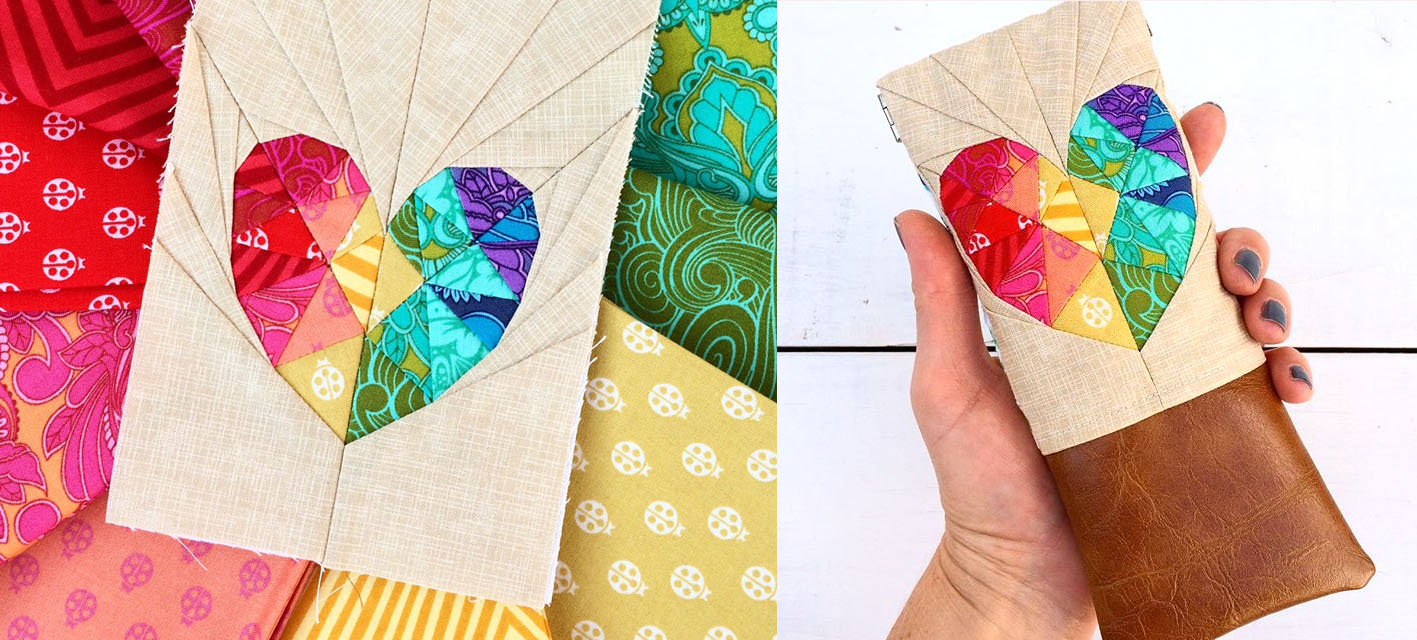
The pattern includes directions for making the tall pouch, which is perfect for glasses, pencils, or a rotary cutter, as well as the small coin pouch, both shown above.

Also included is the Write On pencils paper piecing pattern to create the options shown below. It can be used with the bottom accent or made into the full pouch. The pencils can also be used for a variety of other projects, too. It’s easy to resize the pattern or add more pencils or other elements to the pattern.
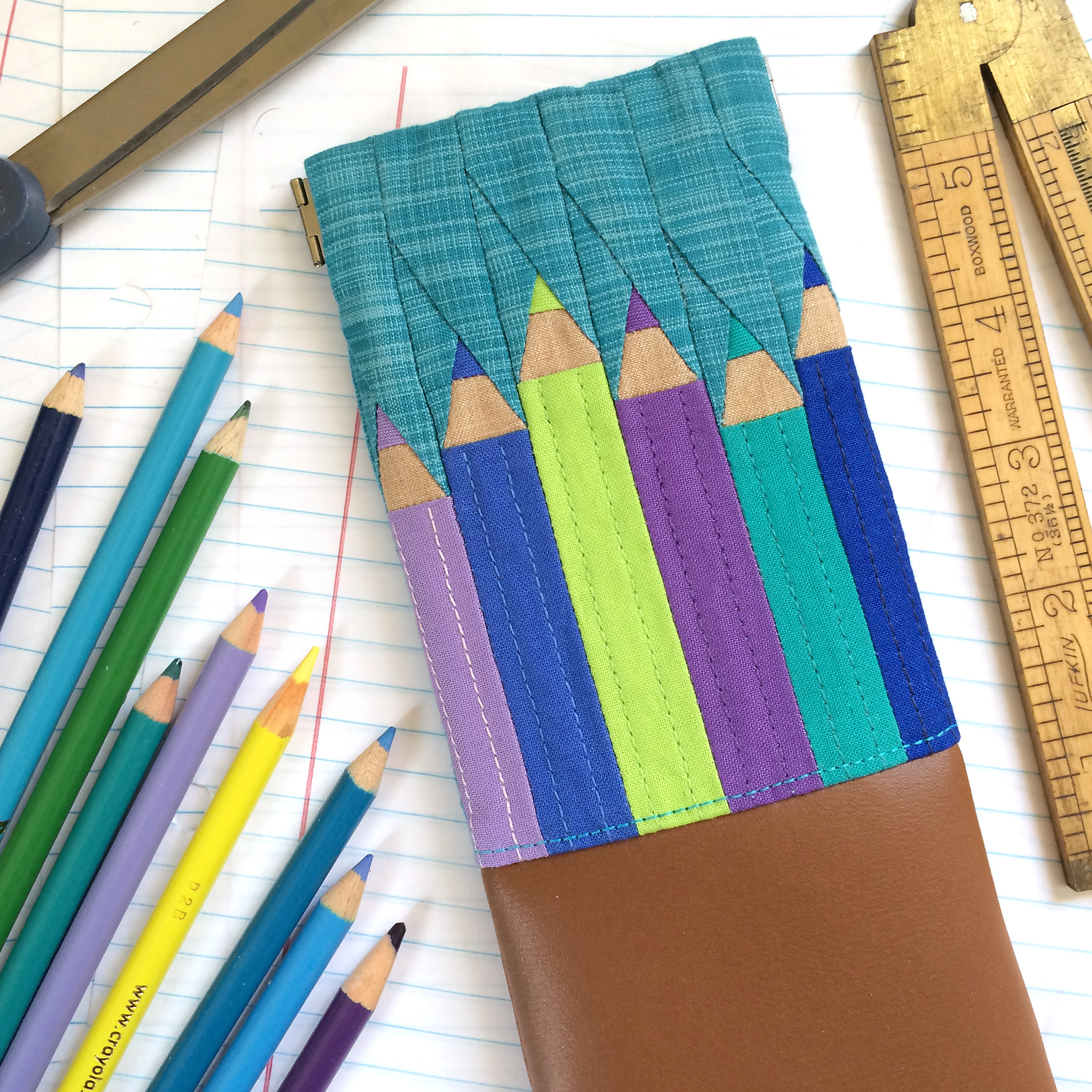
Pencils Hero 2

IMG_0283

In the pattern I talk a bit about how to customize the pouch to any size you wish, and wanted to share a few more variations here today, including how to make a perfect gift set for anyone of any age!

The set below shows the two sizes included in the pattern, plus a third size which is perfect for carrying cards and cash. To create this third size, cut the pieces for the top of the tall pouch as indicated in the pattern (6.5″), but do not include the bottom. Then just cut the lining pieces to the same height and assemble.

IMG_2080 edit

Consider personalizing the pouches with fun notions, such as stamped leather tags or decorative accents. Hmmm, I wonder who these are for?! I found the metal plate accent in the paper crafting section of Hobby Lobby. It is Tim Holtz brand.

Also, adding a short chain and key ring makes any pouch the perfect grab and go wallet.

blackdetails

black cards 3

I tried a few options and positions and decided that I preferred sewing the chain to the inside of the pouch right below the frame sleeves, as shown below. This way the chain and ring can be kept inside or pulled out through the top and the frame closing gives it some added security.

You can find a variety of chains and rings in the jewelry section of any craft store.

threeupsew

This is a fun pattern that can be customized in so many ways, with any of your favorite materials or patterns. Try a quilt block design you like, another paper piecing pattern, or even some selvedges. If you would like to use the 4.5″ frames (or any other size you may find), simply add the additional width to the cut sizes of your pieces. For example, if using a 4.5″ frame, vs the 3.5″ used in my pattern, simple add 1″ width to all your pieces.

heartvariation

I’ll be sharing more sizes, shapes, and ways to play with this pattern over the next months, too, so stay tuned! Please tag your pictures with #FlexFramePouch and #WriteOnPattern so I can see all your awesome creations!

Enjoy! ~ nicole

Reusable Bowl Cap Tutorial

Reusable Bowl Cap Tutorial | lillyella stitchery

Help save the environment and look cute doing it! 😉

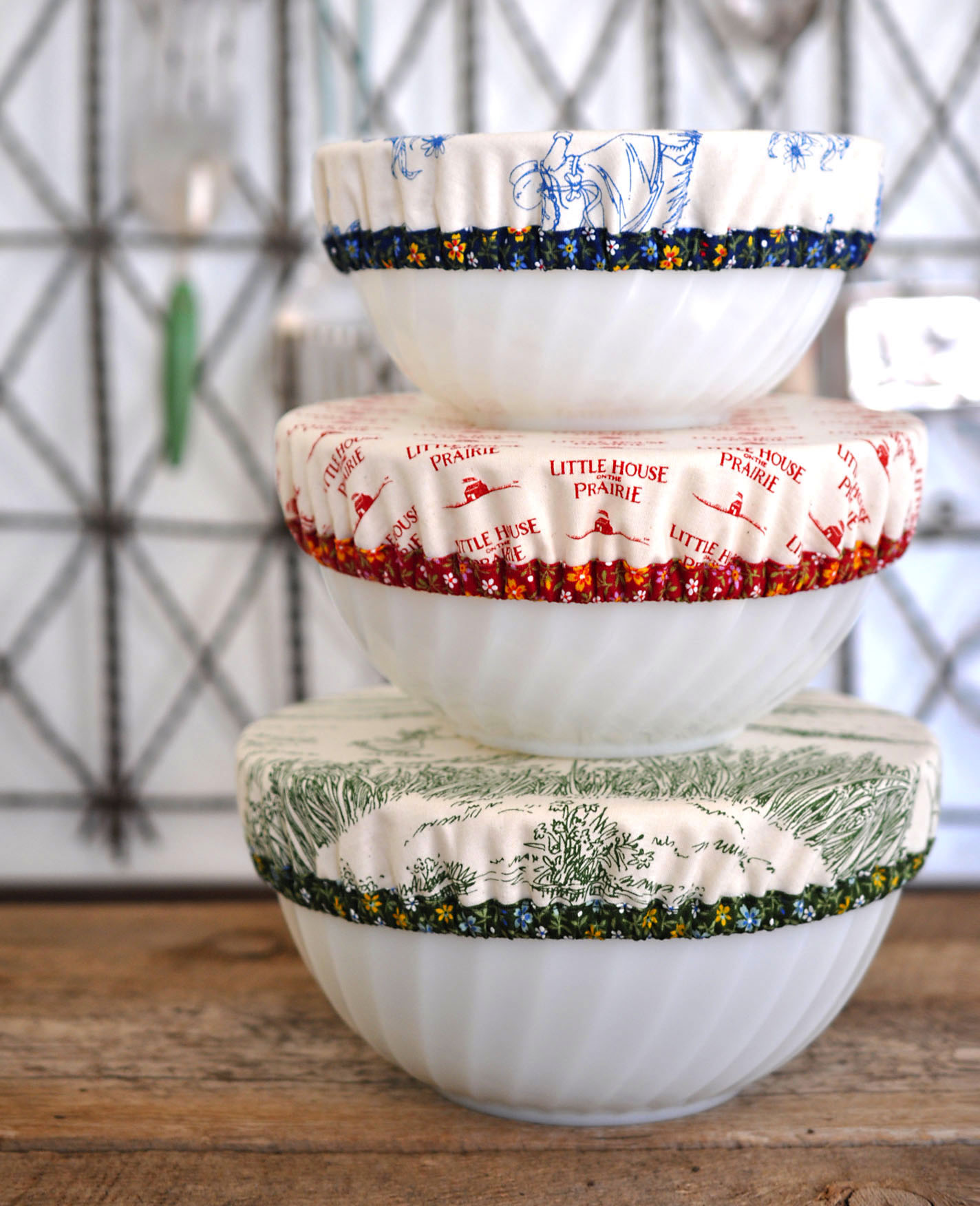
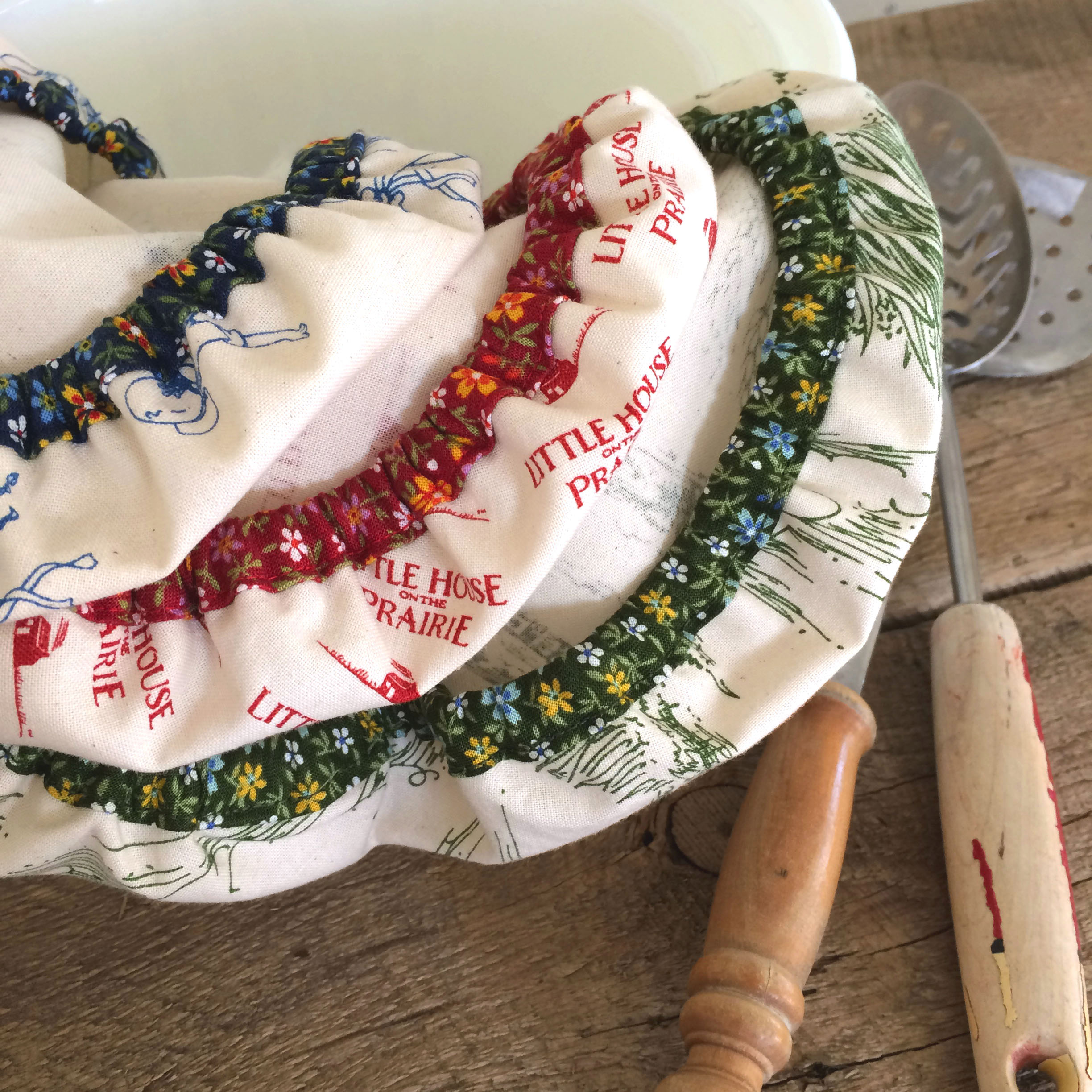
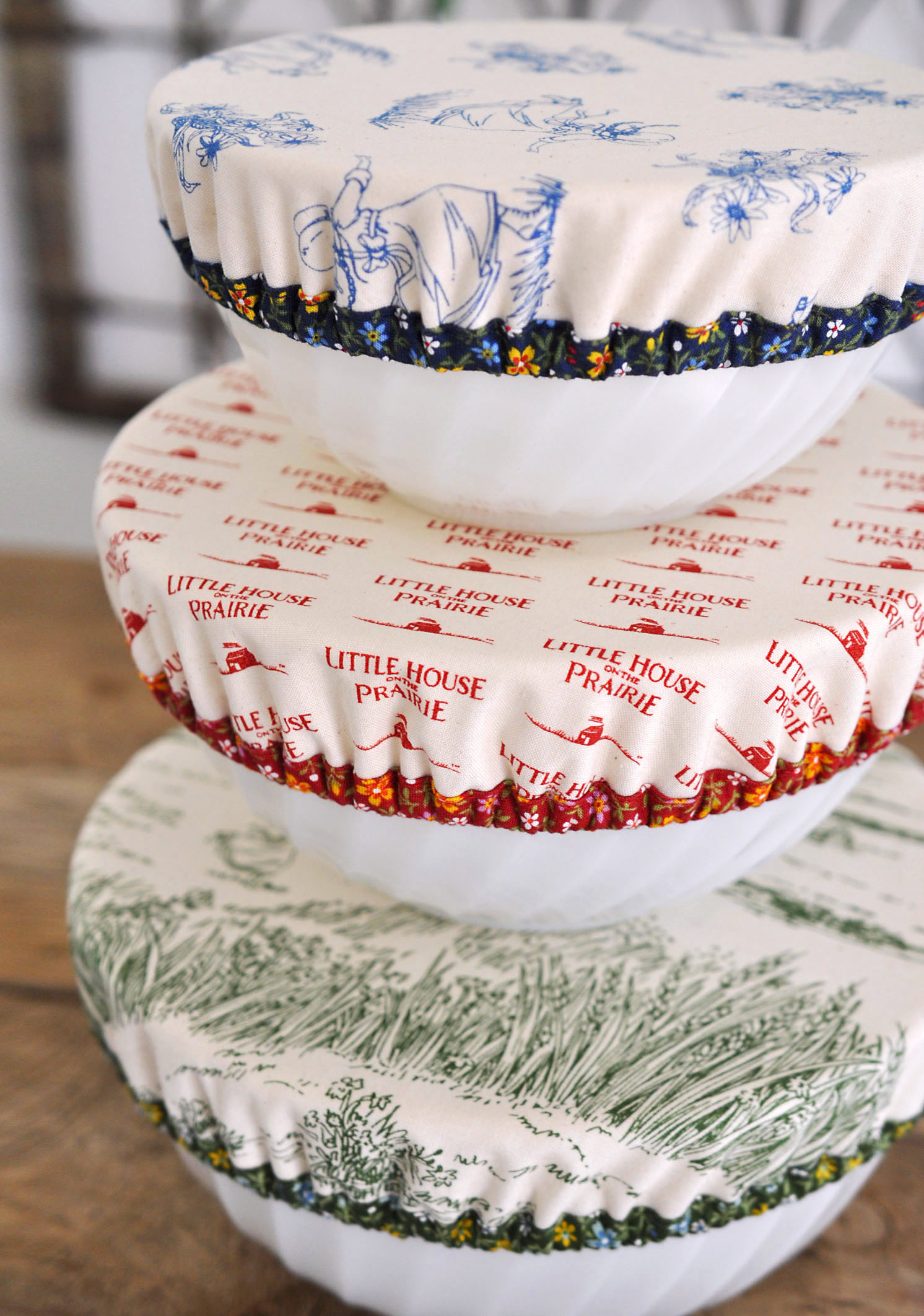
These reusable bowl caps are easy to make and customizable to fit any dish. You can use cotton alone for a washable cap, or add iron on vinyl for a more waterproof cap that can be wiped clean.

Reusable Bowl Cap Tutorial | lillyella stitchery

This tutorial includes directions for determining what size to cut your pieces, how to make bias binding, and how to construct the bowl caps.

Click here to download the free pattern.

The fabrics I used here are from the Little House on the Prairie line by Kathy Hall for Andover Fabrics and they couldn’t be more perfect! Those little florals mixed with the scenic prints are absolutely adorable.

Reusable Bowl Cap Tutorial | lillyella stitchery

I just love making these covers and find them handy for some many things. I always use old Pyrex and Fire King bowls that did not have lids, so using these makes me much happier than using plastic wrap! They also make great gifts. Pick up a cute bowl (or set) at a thrift shop, make a matching cover and give it as a housewarming or shower gift.

I hope you enjoy this tutorial! Share your project photos on Instagram & Facebook with #reusablebowlcap!

Reusable Bowl Cap Tutorial | lillyella stitchery

Paperie Blog Tour + New Love Story Pattern

IMG_2667 edit 1

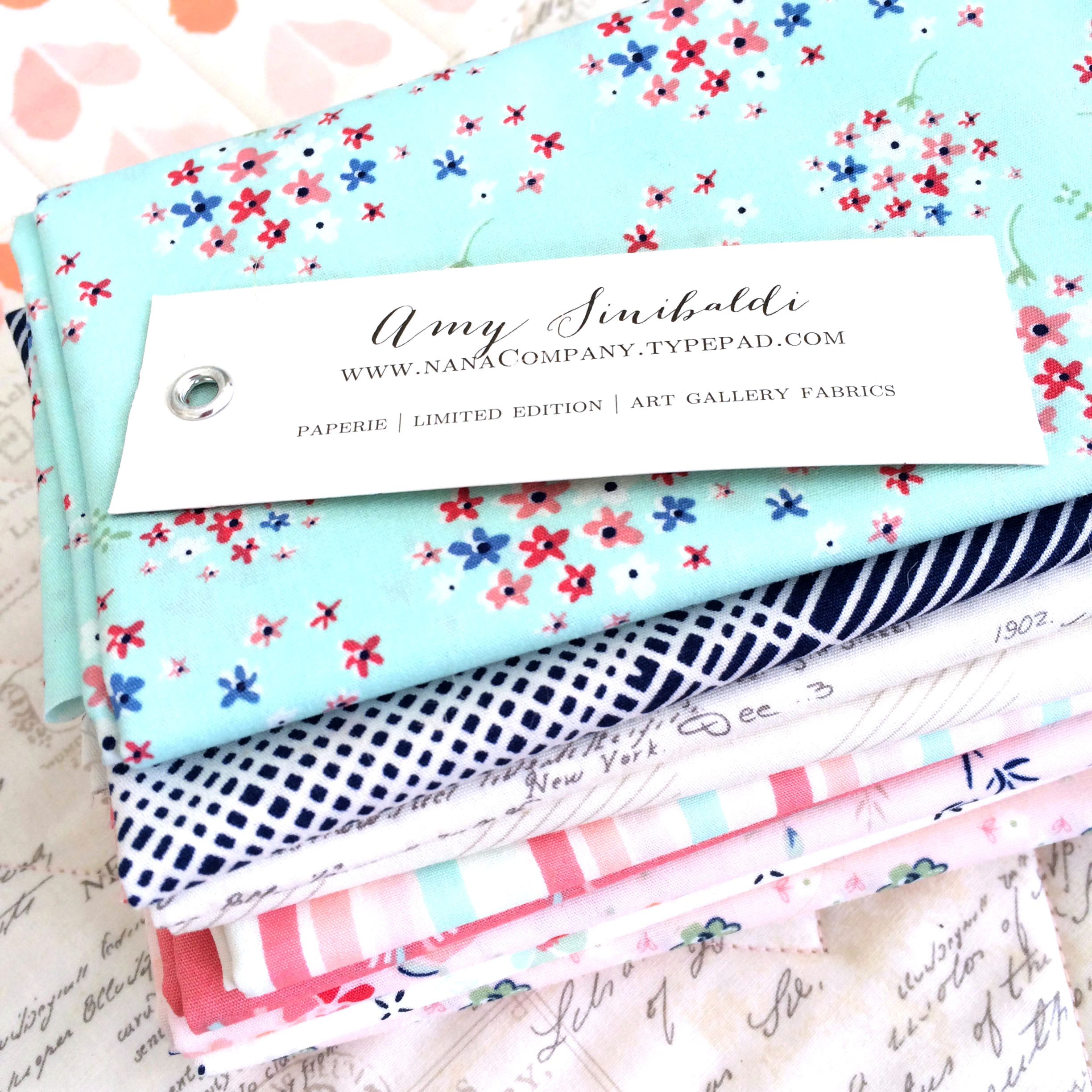
It’s funny how things work out. The way life’s puzzle pieces always end up fitting together. I first designed the Love Story Pattern for my class at the Swapaholics Retreat last September. Amy Sinibaldi was also teaching and her debut fabric line, Paperie, had not yet been announced when I was prepping for the retreat.

Flash forward a few months to 2016. I’m amping up my pattern in preparation for release and Amy invites me to join her Paperie Blog Tour. I think you’ll see that her fabric and this pattern go together like sprinkles and donuts. And not that pink hearts are ONLY for Valentine’s day, but what perfect timing, wouldn’t you say?

Undercover Maker Mat featuring Paperie Fabrics | lillyella stitchery

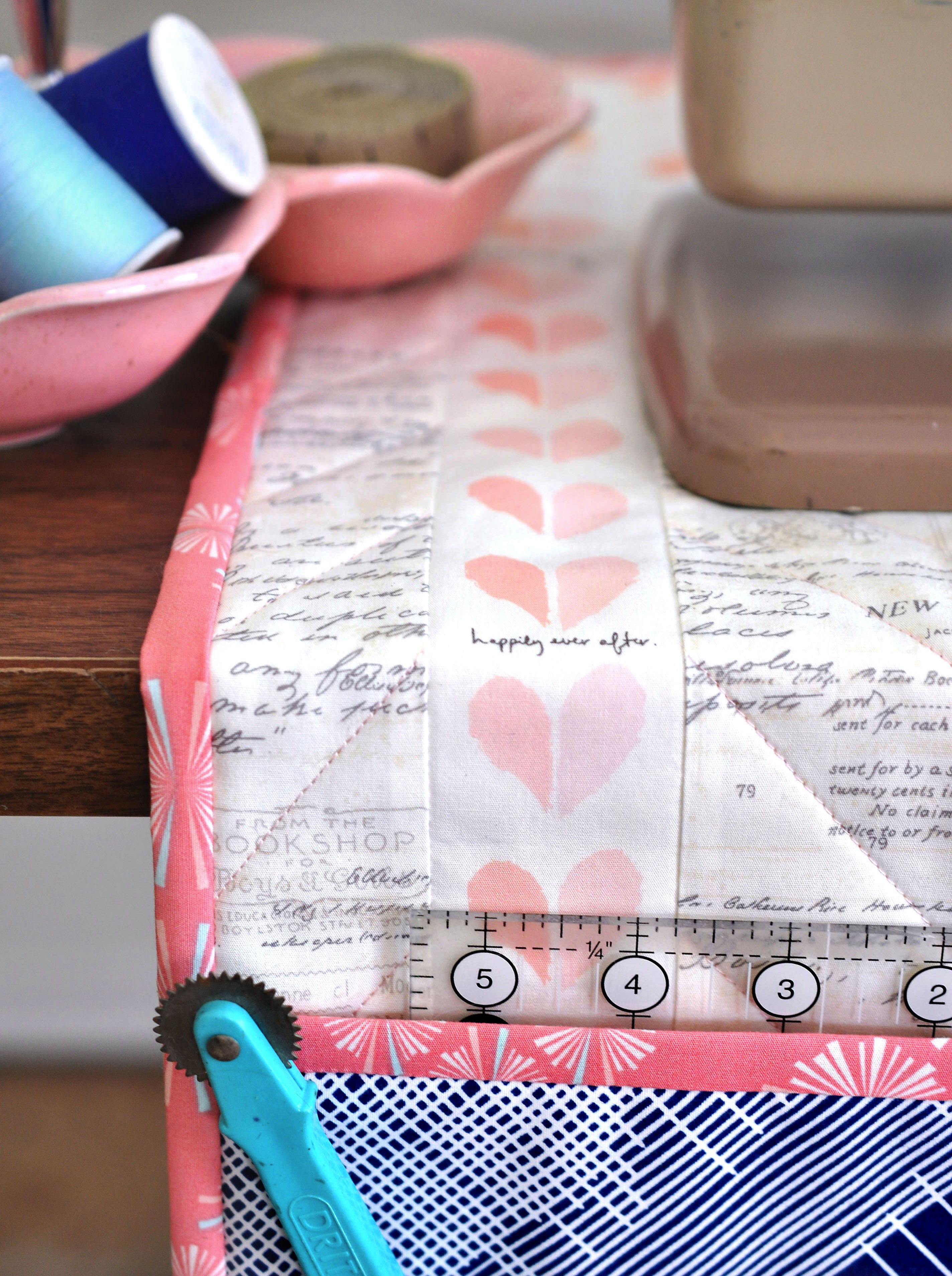
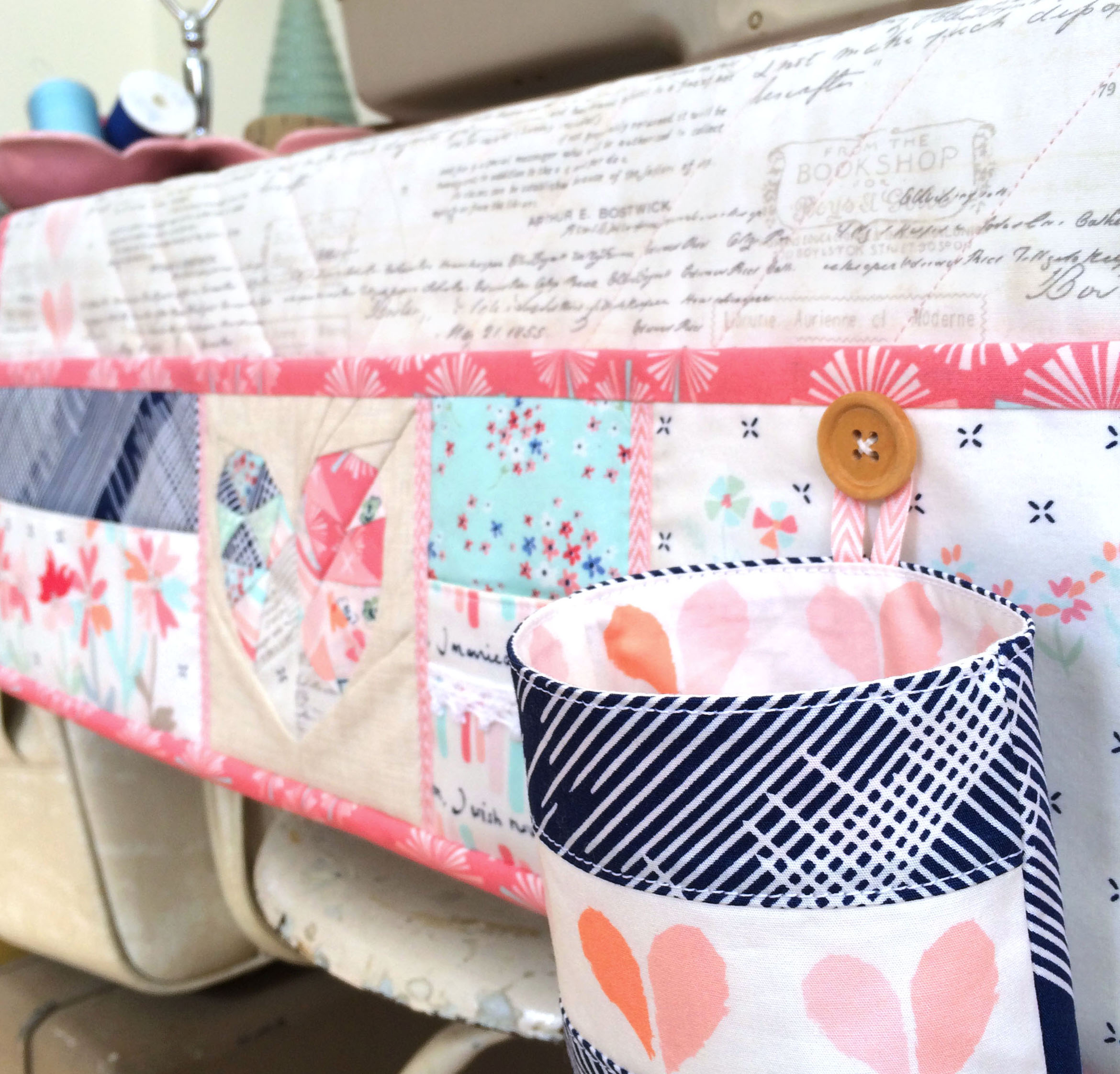
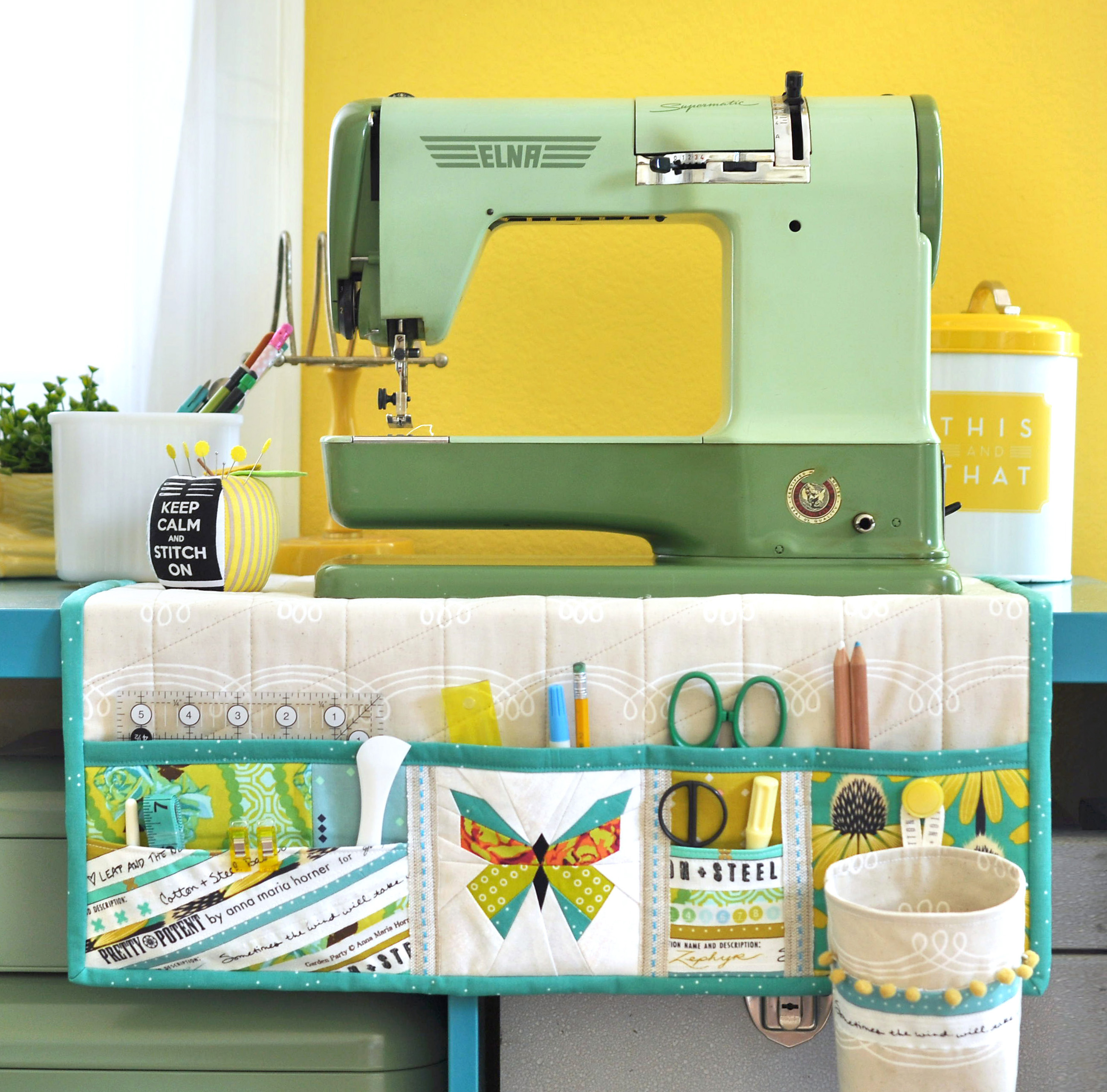
As usual, I had trouble wrangling in all my ideas. I did know for certain that first I wanted to make my Undercover Maker Mat (download the free pattern here) using the 5″ Love Story block in place of the butterfly charm block used on the original. This mat is such a fun and useful project that sews up quick and lets you showcase your favorite fabrics.

I decided to make the secondary pockets on this one in solid prints, rather than the selvedges, so I could really show off the line.

Undercover Maker Mat featuring Paperie Fabrics | lillyella stitchery

I was torn between using the texty print or the hearts for the main body of the mat, but now that it’s all finished, I don’t know how it was even a question. The text is just perfect and the strip of hearts pieced in just plain makes me happy!

Undercover Maker Mat featuring Paperie Fabrics | lillyella stitchery

I then carried the heart print over to the removable thread catcher by piecing a strip into the front and using it on the lining. I think it really just balances it all out perfectly.

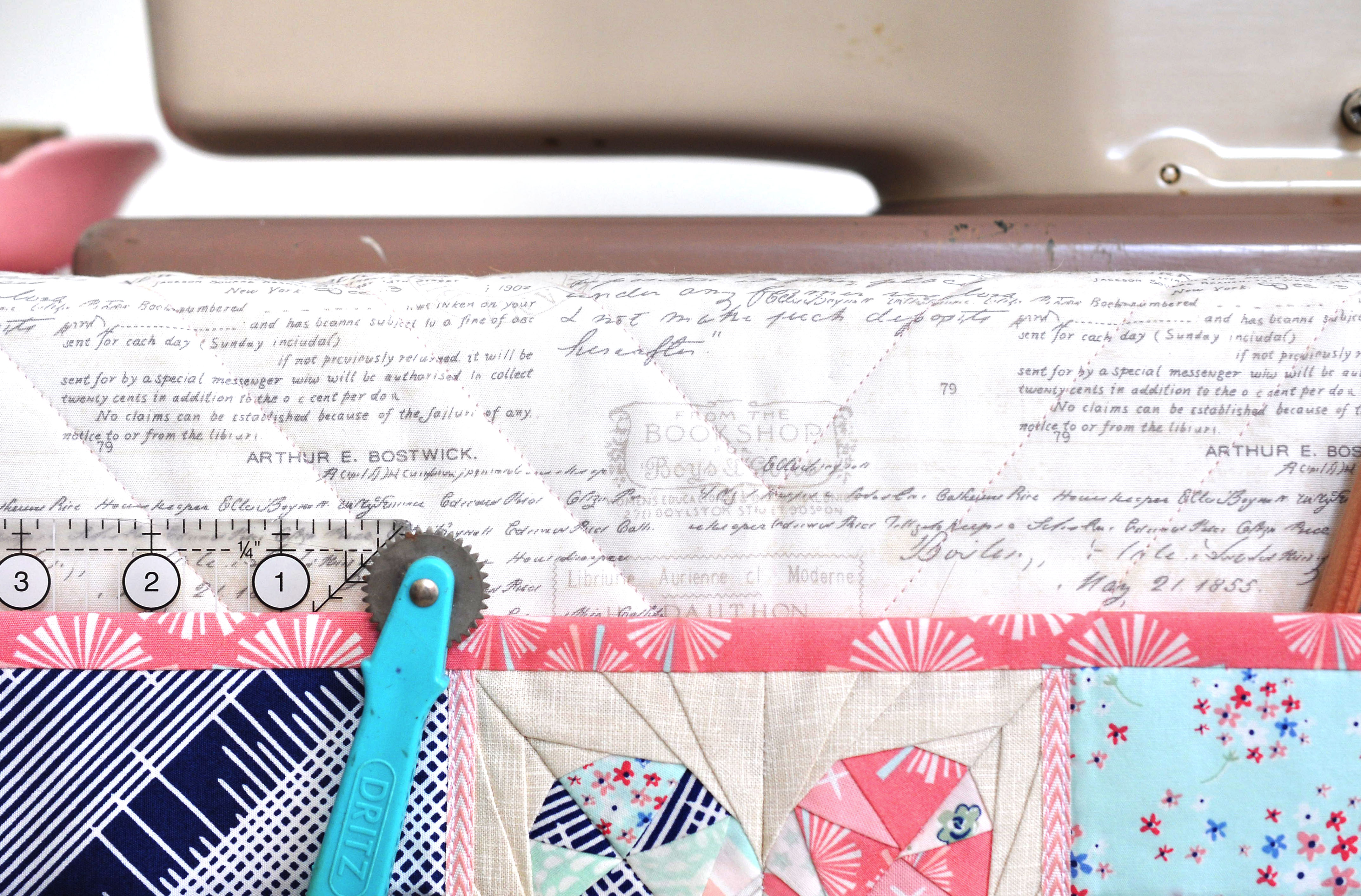
I used a delicate pink chevron trim on the pocket panel and added a bit of crochet lace on the secondary pocket – in true Amy style!

Undercover Maker Mat featuring Paperie Fabrics | lillyella stitchery

Thanks to the expert advice my official quilter, Sari, I went with a large chevron pattern for the quilting on the mat body. It echos the seams of the heart block perfectly (thank you very much) and also ties in the trim. I used a pale pink Aurifil thread that gives it just the tiniest hint of color and I couldn’t love it more!

Undercover Maker Mat featuring Paperie Fabrics | lillyella stitchery

I kept trying to find a way to use this pretty aqua trim on the pocket panel, but it just felt overpowering. It did, however, work out perfectly for the side ties!

So, what do you think? Is this mat your style? I’ll be giving it away on Instagram next week (and a bundle of fabric!), so stay tuned for that!

• • • • • • • • • • • • • • • • • • • •

Love Story + Cross my Heart Pattern | lillyella stitchery

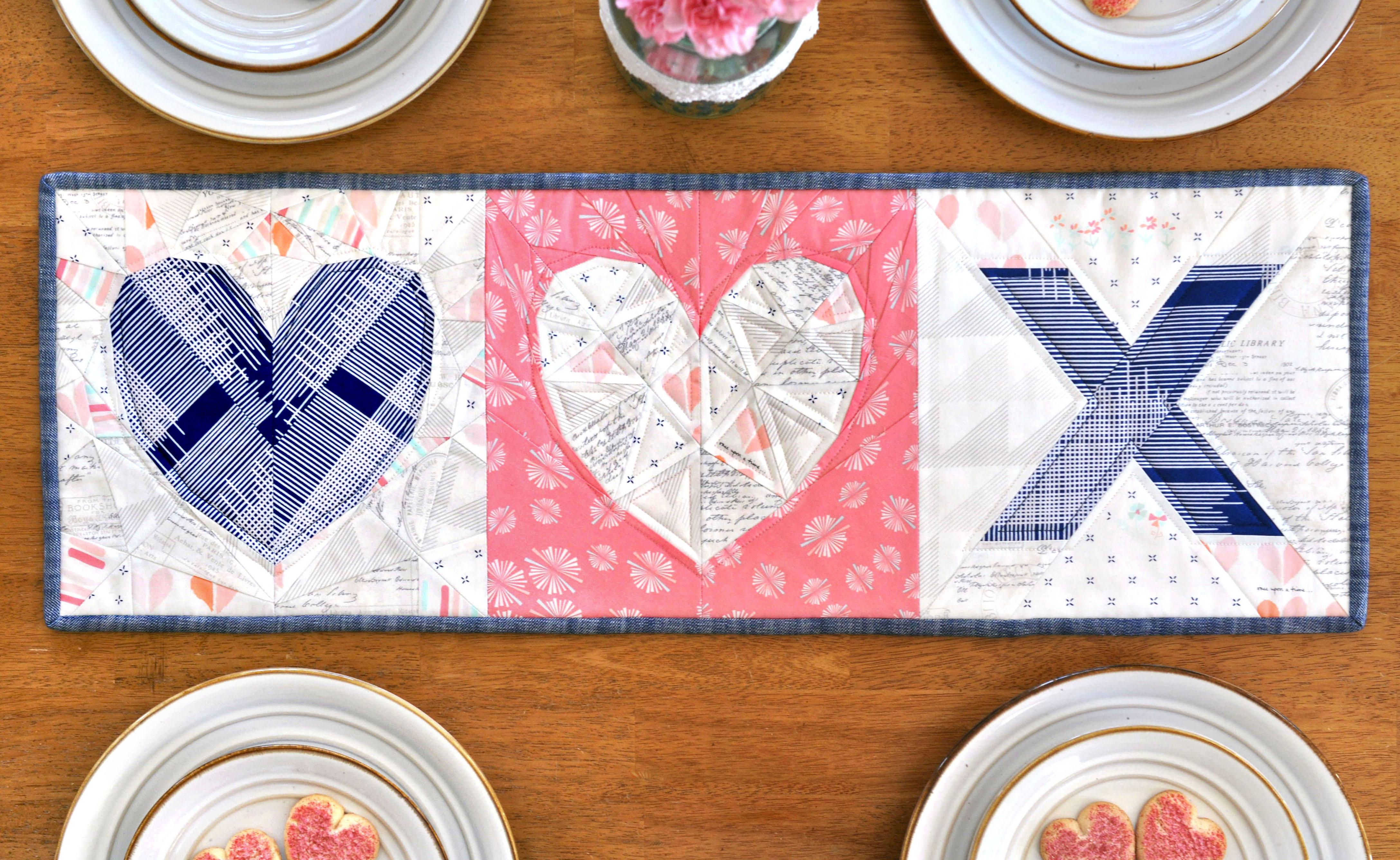
Another idea that I just knew I had to run with was designing an X block that coordinated with Love Story. Like Xs and Os, but with a cute heart instead! I’m calling it Cross my Heart and you can download it for free here.

I thought it would be an adorable mini quilt with 4 blocks in a large square, or as a set of pillows (or a two sided pillow!) or a table runner, which is what I decided to make for my sample project.

Love Story Pattern | lillyella stitchery

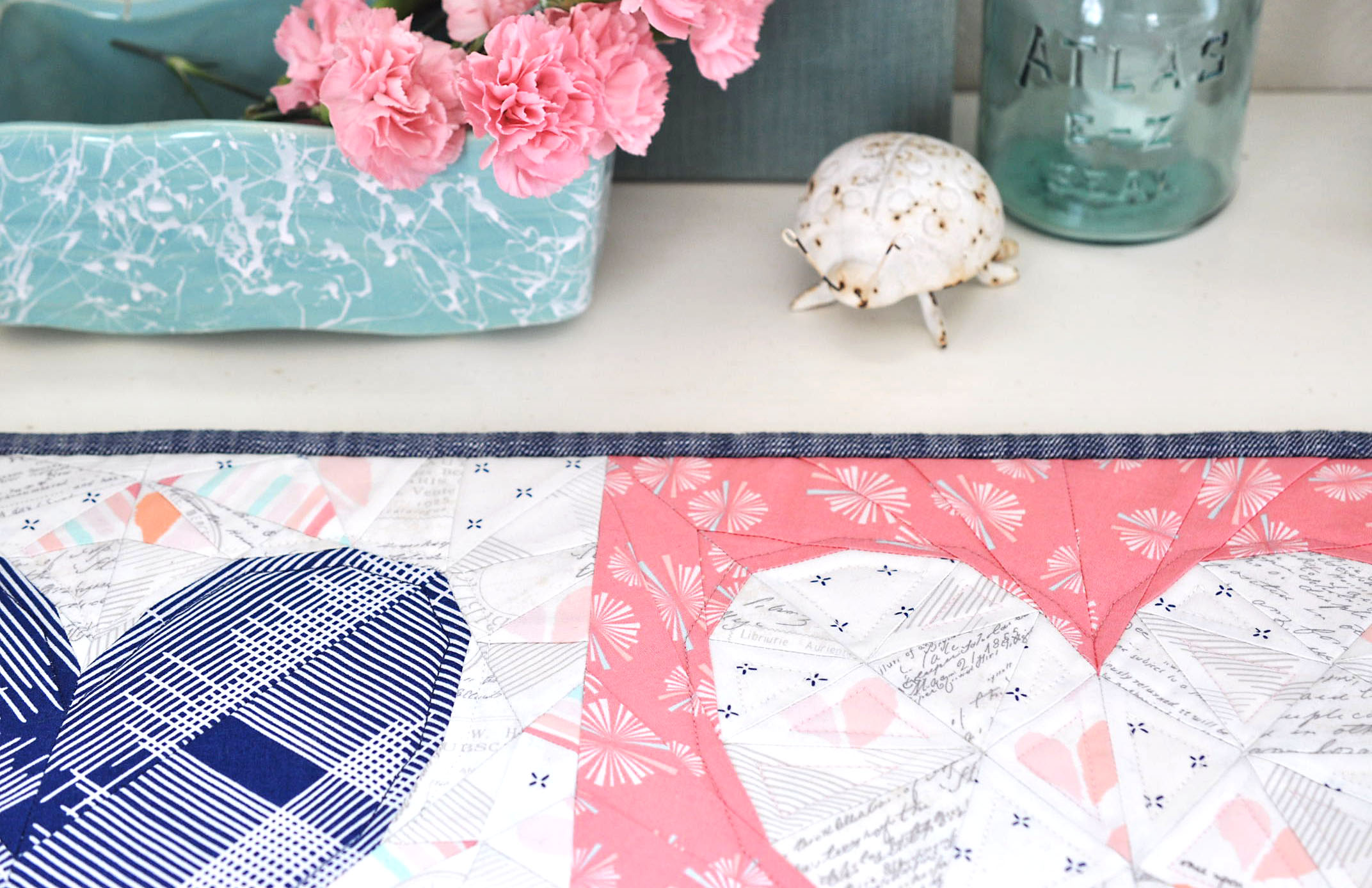
My Love Story pattern includes two block designs – Poetry (the pink block) and Prose (the navy and white block). I wanted to showcase them both, along with the X, so I thought a little asymmetry would be fun! I used the 10″ blocks here, and the X pattern also includes a 5″ block (how about a set of heart and X coasters?!).

Love Story Pattern | lillyella stitchery

I love how striking the bold pops of pink and navy in this line are mixed with all the beautiful, soft low volumes. By random chance, I had a piece of my favorite chambray denim on my cutting table when I was feverishly trying to decide what to bind my runner with. It was a match made in heaven! The denim pairs so amazingly with this line, it started my mind racing with quilt ideas using Paperie and the new Art Gallery denim line that is coming out soon. SO EXCITED!

Love Story Pattern | lillyella stitchery

Love Story Pattern | lillyella stitchery

I’ll be sharing some design ideas and other fun Love Story projects (including a lap quilt pattern) here and on my Instagram feed over the next couple weeks. You can also check the hashtags #lovestorypattern and #crossmyheartpattern for more inspiration. As always, I can’t wait to see what you all create!

Love Story + Cross My Heart Patterns | lillyella stitchery

Be sure to check out all the other stops on the Paperie Blog Tour for all sorts of swoon worthy projects! You can find links and photos in Amy’s instagram feed and on her blog.

• • • • • • • • • • • • • • • • • • • •

Love Story Pattern | lillyella stitchery

Now I am in desperate need of a nap! So I will leave you with some more eye candy inspiration! Above is the original Love Story block as it was designed to fit my flex frame pouch project for the retreat.

For the pattern release, I squared off the block and made a coordinating reverse design where the heart is solid and the background is faceted instead. I love the possibilities this opens up for color play and layout ideas!

Love Story Pattern | lillyella stitchery

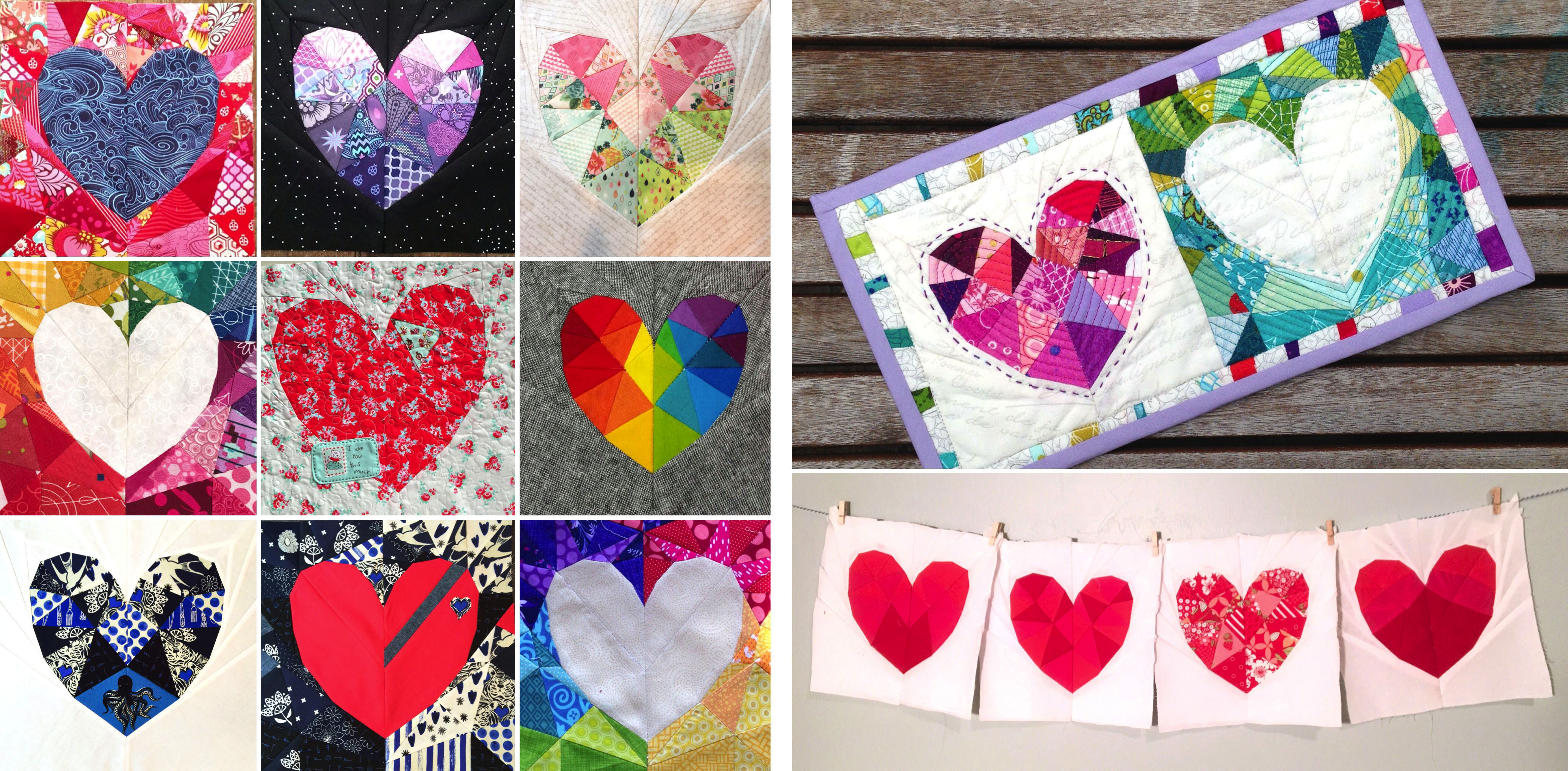
Here are just a few blocks that my amazing testers sewed up. I’ll be sharing their finished projects soon! You can pick up a copy of the pattern on sale for $6.50 now thru Valentine’s Day in my Payhip, Etsy or Craftsy shops.

happy stitching! ~nicole

Undercover Maker Mat Pattern

Undercover Maker Mat free pattern | lillyella stitchery

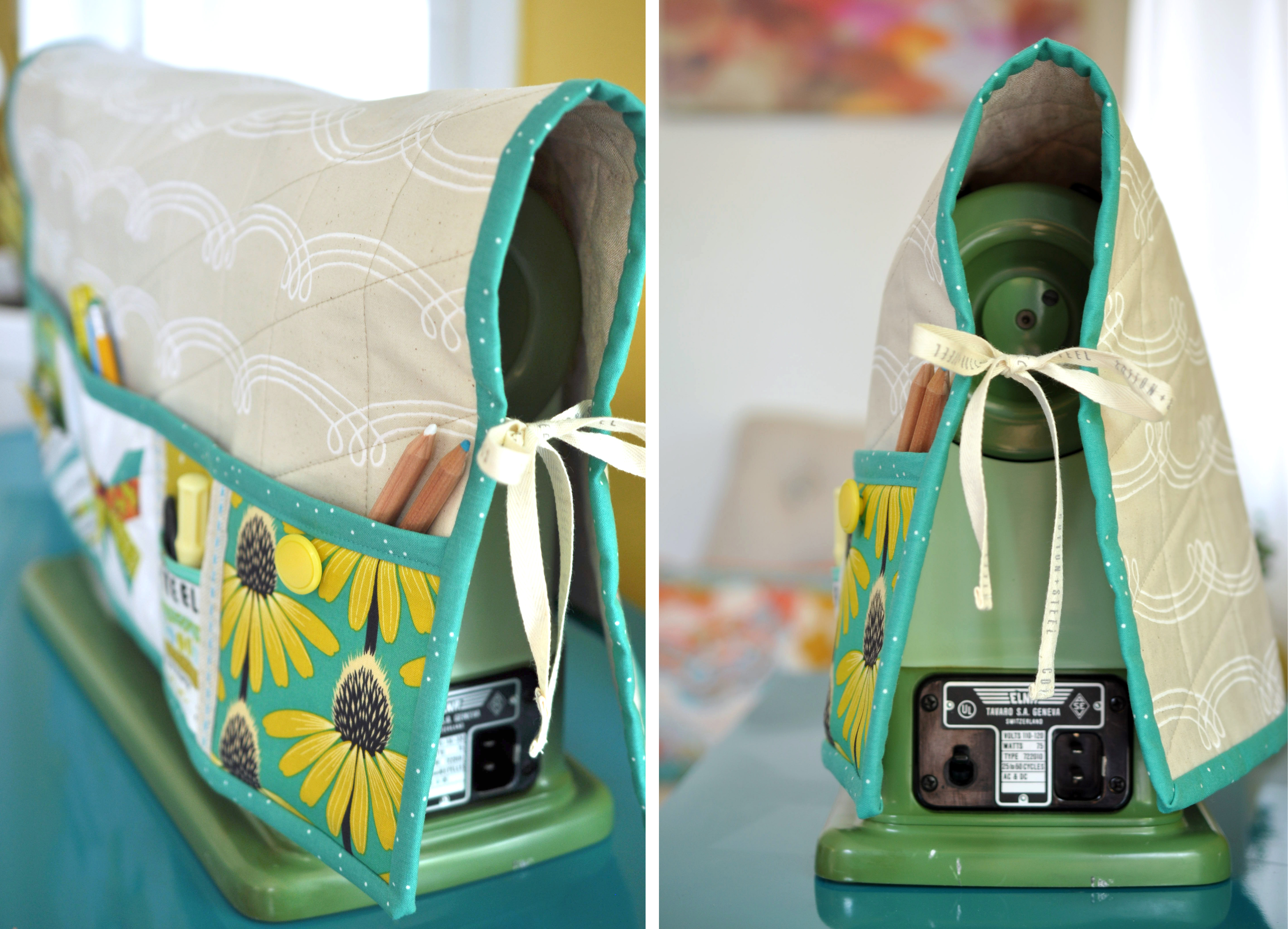
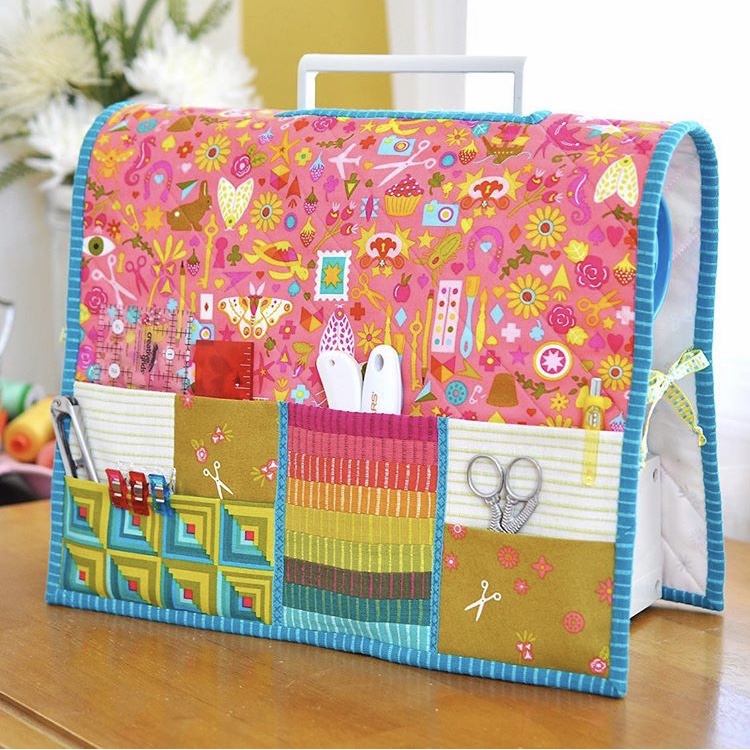
This dual purpose sewing space organizer has double pockets and a removable thread catcher to keep all your notions at hand and your workspace tidy. It goes from under to {machine} cover when not in use with side ties to keep it in place.

Undercover Maker Mat free pattern | lillyella stitchery

Click here  to download the PDF pattern.

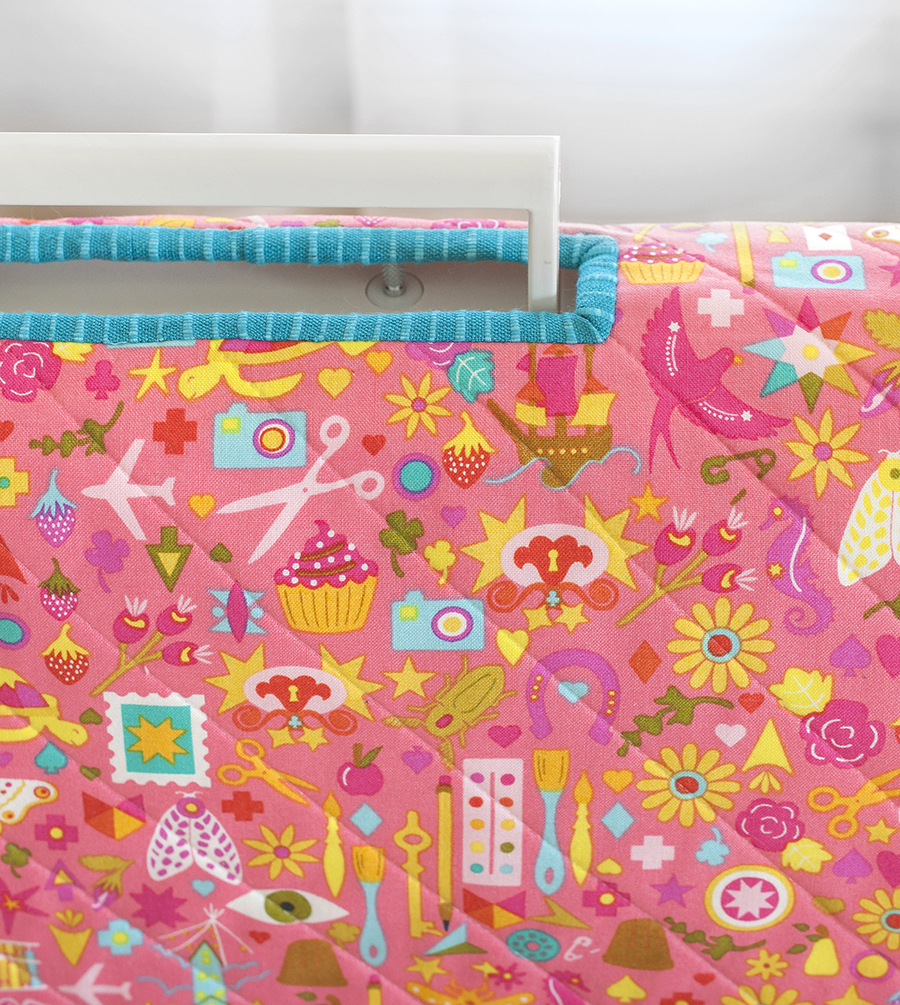
I also shared a pattern hack for adding a handle opening to this pattern, shown below, if your sewing machine has a carrying handle and you can find the directions for that here.

I have hosted several sew alongs for this pattern and you can find the previous posts here, they contain some additional tips, tricks and tutorial links.

If you have any questions about the pattern, feel free to contact me anytime. Tag your photos with #undercovermakermat so everyone can be inspired!

Festive Flutter Tree Mini Quilt Pattern

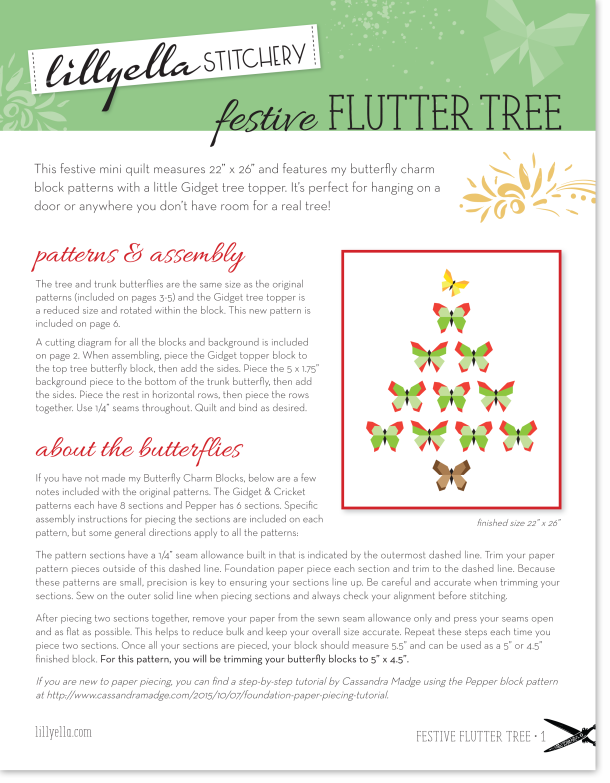
This festive mini quilt measures 22” x 26” and features my Butterfly Charm Block patterns with a little Gidget tree topper. It’s perfect for hanging on a door or anywhere you don’t have room for a real tree!

Click here or the image below to download the PDF pattern.

If you have any questions about the pattern, feel free to contact me anytime. Tag your photos with #festivefluttertree and #butterflycharmblocks so everyone can be inspired!

Festive Flutter Tree Pattern | lillyella stitchery

Midnight Bite Treat Bag Tutorial

Midnight Bite Treat Bag Tutorial | lillyella stitchery

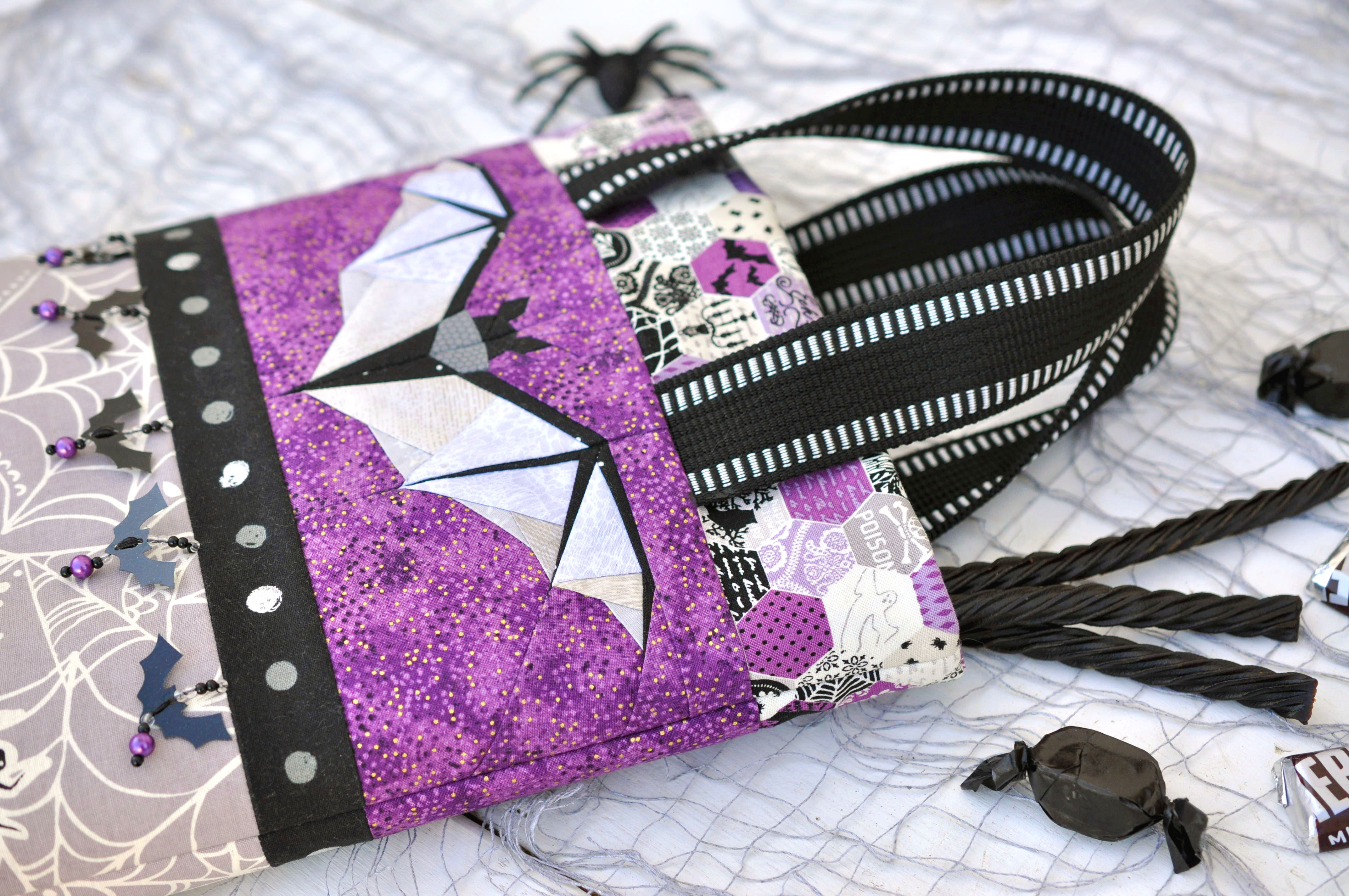
After falling in love with that hexie print, I found the matching purple fabric and there began my plan! When I pieced the 10″ Midnight Bite block, I just knew it had to become a treat bag. This project slowly came together as I found each new piece and it couldn’t have worked out better!

The handles are webbing I found in the trim section of Joanns, the silver is reflective so it’s perfect for night time candy hunting! Then there is the bat trim… I mean, come on! It’s even purple. No brainer. I also found this at Joanns. It’s made by Simplicity and was on an endcap of an aisle. There were spider pom poms too, which I also have big plans for.

Midnight Bite Treat Bag Tutorial | lillyella stitchery

This bag was quick and easy to make and can be customized in a variety of ways. You can use any fabrics, a variety of trims or fabric for the handles, and you can even adjust the measurements to modify the size for your preferences. It doesn’t even have to be just for halloween, it would make a perfect holiday gift bag!

This tutorial is really basic (because I have more bats to make!), but if you have any questions, just leave a comment below or shoot me an email. Please read thru the entire tutorial before beginning.

PREPARING YOUR BAG PANELS:

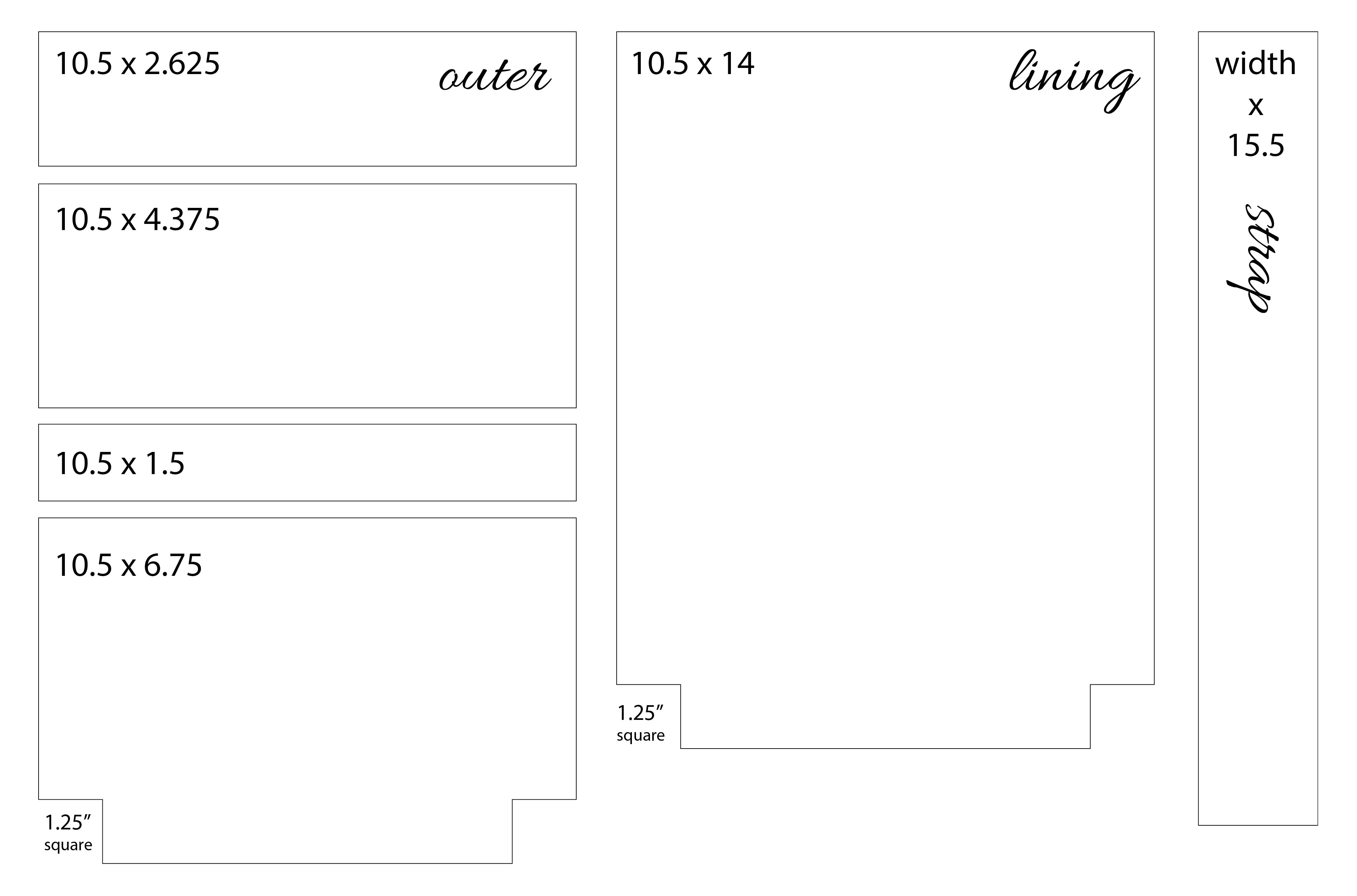
The finished size of this bag is 10″ wide x 12″ high x 2.5″ deep at the bottom with a 4.5″ drop. Below are the trim sizes for the outer pieced panels, the bag lining and the handles. You will need two of each piece. My handles are about 1.25″ thick but you can make them any size you wish.

My bag has a small boxy bottom. Simply eliminate the corner cuts if you don’t want a boxy bottom. You may also want to shorten your bag if you do this. I wanted my bag handles to be just long enough to slide over my hand easily and hang from my forearm, but not so long that the bag would drag on the ground if a little one was carrying it. You can adjust this measurement to be comfortable for you.

Midnight Bite Treat Bag Tutorial | lillyella stitchery

Begin by piecing the three bottom outer panel pieces with a 1/4″ seam. In my bag, this is the bottom spiderweb print, the strip of dots and the focal bat (*see ‘Adding Decorative Trim’ section below for options on how to add trim accents).

Midnight Bite Treat Bag Tutorial | lillyella stitchery

The focal bat panel is the 10″ block from my Midnight Bite pattern, the finished width is 10.5″ and I trimmed the height of the block to 4.375″. This odd measurement was simply based on how I visually liked the bat to be framed, you can make this focal panel any size, just be sure to adjust the lining measurement equally. The same applies to the top band of my bag (the hexie print), the measurement was based on the size of the hexies.

Next you will add the handle before piecing on the top band of fabric.

Midnight Bite Treat Bag Tutorial | lillyella stitchery

Lay your top fabric right side up, right reading. Lay your handle on top spacing the two ends equally from the center. You can line up your handles with the bottom edge of your fabric or drop the ends down about 1/4″ below your fabric to give a little extra grip in there. My finished bag has about 2.5″ between the handles (it’s shown a little wider in this photo which I took after the fact). Pin in place.

Next you will lay the pieced section of your outer panel right side down, upside down, on top of your handle piece, lining up the bottom edges. Sew along the bottom edge with a 1/4″ seam. I recommend going back over the handle areas a couple times and backstitching well on either side of them.

Press the larger piece down. NOTE: My handles could not be ironed, so be sure to test your material if you aren’t sure.

Midnight Bite Treat Bag Tutorial | lillyella stitchery

Repeat these steps for the other side of your bag. After my two outer panels were assembled, I used fusible fleece  on them to stabilize my bag and I love the feel of it. You can also use batting and then quilt your panels or do some edge topstitching to hold it in place. If you’d like a lighter bag, you can use a medium weight interfacing, but I do recommend using some type of interfacing on the back of your outer panels. I did not use any interfacing on my lining.

CONSTRUCTING THE BAG:

Next you will take your two outer panels and place them right sides together. Sew with a 1/4″ seam down the left and right sides and across the bottom. You corner cut outs will be open. Repeat these steps for the two lining pieces, but leave a large gap in the bottom seam for turning. Just sew about 1/2″ in from either end.

To sew the boxed corners, keep your pieces wrong sides out. Open up the piece a bit and fold one inner side seam down to the inner bottom seam, lining them up and lining up both cut edges of your corner cut out. Sew along the edge with a 1/4″ seam. Repeat for the other side of your bag outside and your lining.

To sew in your lining, turn the outside of your bag right side out. Keep your lining wrong side out. Slide the outside of your bag into the lining, the two pieces will be right sides together. Line up the top edges making sure to match the side seams and sew around using a 1/2″ seam.

Turn your bag right side out through the gap in the bottom of your lining. Stitch the gap closed and turn your lining inside your bag. Press around the top and top stitch if desired.

Midnight Bite Treat Bag Tutorial | lillyella stitchery

ADDING DECORATIVE TRIM:

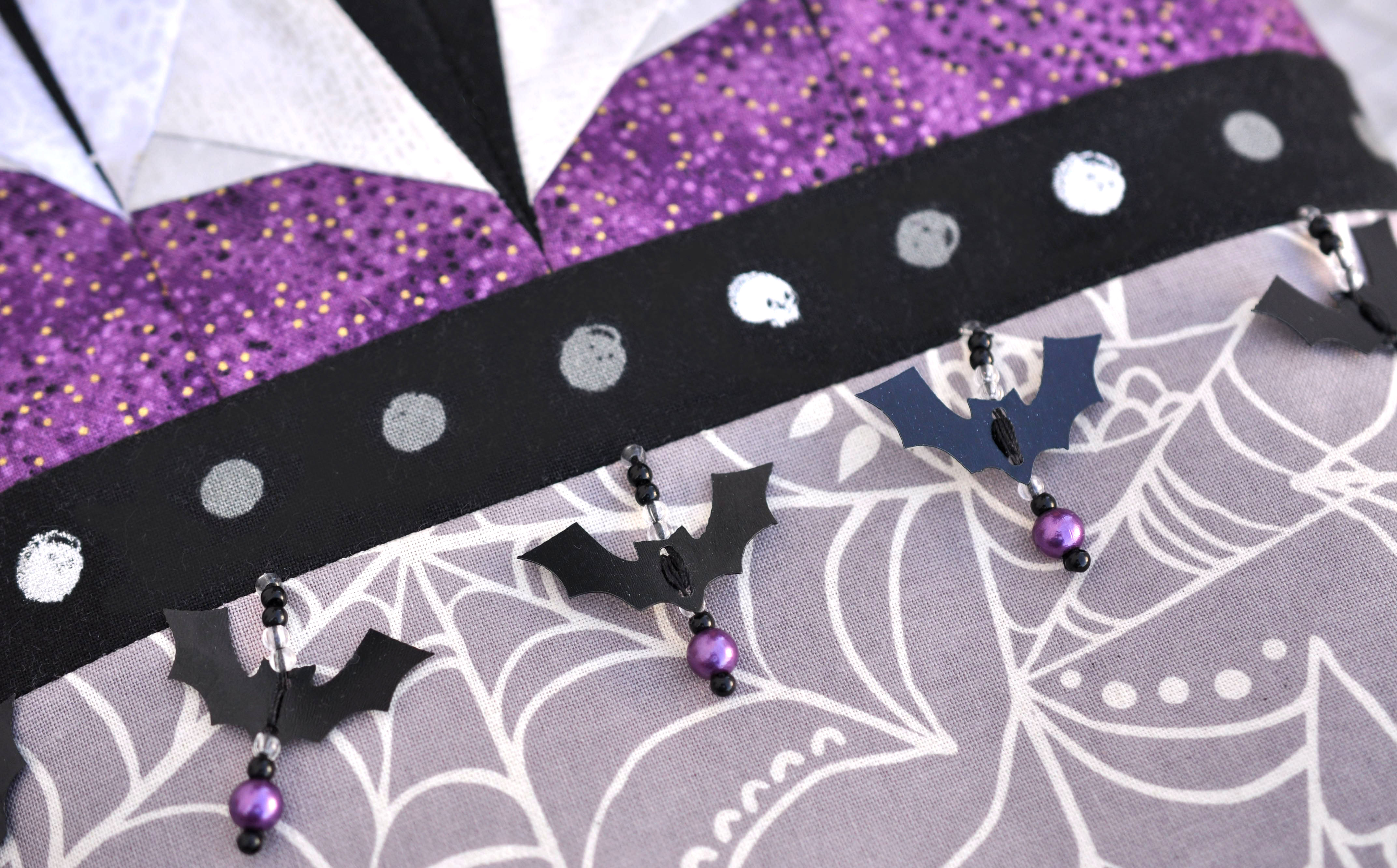
Once all the elements of this bag came together and I was planning the design (see a couple options I was tossing around below), I was going to stitch the bat trim onto the bag panels after they were pieced and then use a piece of woven striped ribbon on top. I liked the added design element but I also wanted to cover the satin ribbon the bats were on because it looked a little generic to me.

Midnight Bite Treat Bag Tutorial | lillyella stitchery

After texting about seven people for their opinions (ya, Im a high maintenance friend), I decided to keep it a little cleaner and just use the bat trim, but I did not want to throw off the balance of the black dotted fabric strip by having the black ribbon of the bats showing. Typically I would sew the trim into the seam, much like piping, but I was concerned about keeping it in place and hitting the beads with my machine foot. I also wanted the bats to fall evenly in line with my dots (OCD, I know). So I clipped the bats off the ribbon and restrung each one then sewed it in place on my bag panels. I did this after adding my fusible fleece to my pieced panels. Since there’s only five bats on each side, it went really quick.

FEATURED FABRICS:

The top hexie print is from the line Happy Haunting by Deena Rutter for Riley Blake (it also comes in orange and black!). I unfortunately have no idea what the purple background of my bat is. I grabbed it last minute at my LQS, but I’ll see if I can find it next time I’m up there. The Happy Haunting line has a purple print with tiny black spiders on it that would match and make a cute background, too. The black strip with the dots is Spellbound from Cotton + Steel and the bottom web print is from Spooktacular, Too (also in the newer Spooktacular Eve) by Maude Ashbury for Blend.

I hope you enjoy this tutorial, happy haunting, friends!

Midnight Bite Treat Bag Tutorial | lillyella stitchery

EPP Table Topper Pattern

Free EPP Table Topper Template | lillyella stitchery
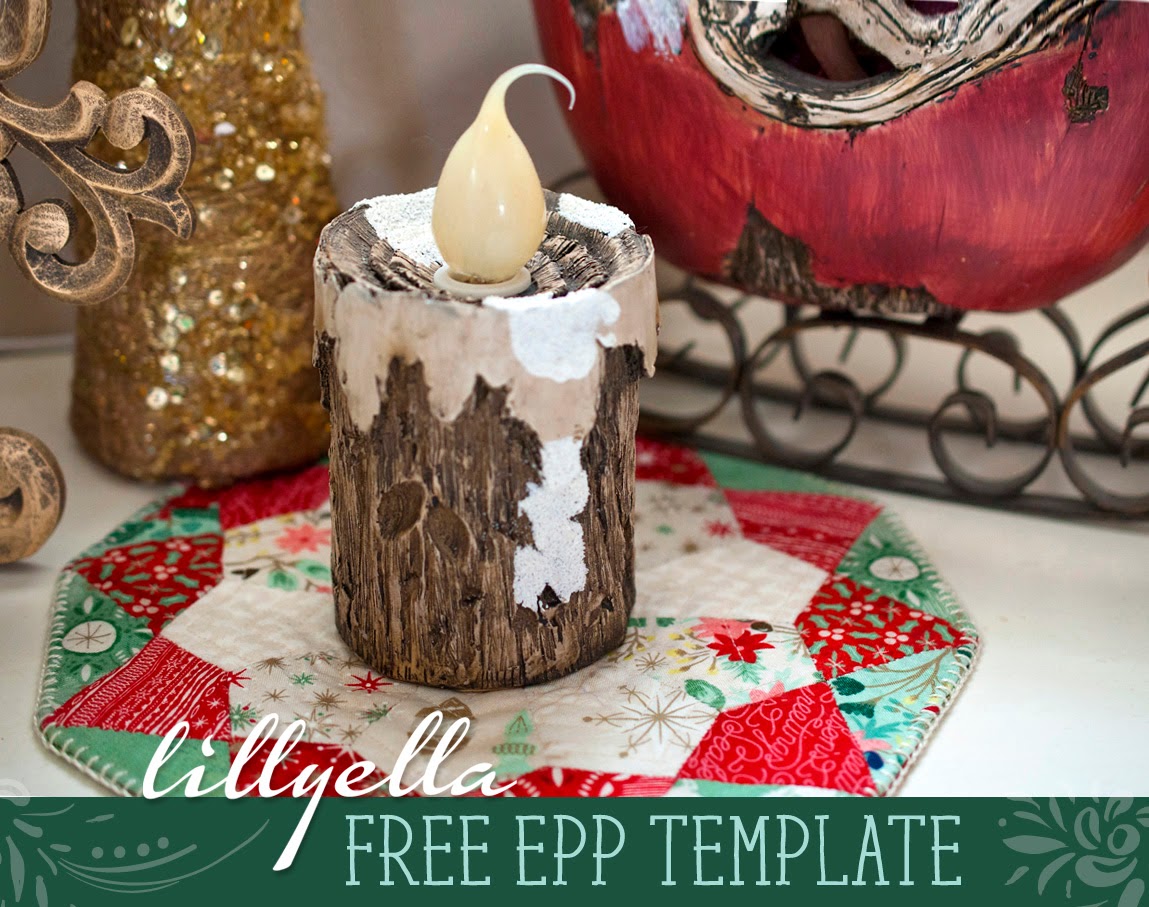
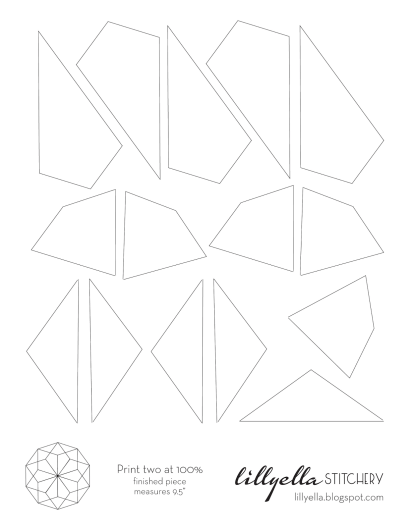
This pattern, or something like it, may very well exist somewhere in the world. But with my 25th & Pine charm pack in hand, I went searching for a small EPP pattern that would be relatively quick and had no luck, so I just drew one up.
I am by no means an english paper piecing expert and everyone has their favorite methods, so I’m just sharing my pattern templates here rather than a full tutorial. I will, however, provide some links to other tutorials for anyone who is new to EPP and explain how I finished my piece. The great thing about it is that all you need is fabric, a needle and thread – no sewing machine or experience is necessary.
This pattern creates a piece that is 9.5″ wide and is designed to be charm square friendly (5″ fabric squares). You can get two center kite pieces from one charm square and more of the smaller pieces, but I used 5 white, 5 red and 5 green charms to create my piece. This pattern is also great for scraps, the biggest piece you need is about 2.5 x 5, but the templates can also be printed larger or smaller to create a different sized finished piece.
Free EPP Table Topper Template | lillyella stitchery
I made mine into a little table topper (isn’t it the perfect little mini tree skirt?!), but it would also be nice used on a pillow, as a trivet or on a bag. You can download a PDF of the templates by clicking the image below. You will need to print two sheets so you have ten of each shape.
I thread basted my pieces because I just haven’t gotten the swing of the whole glue basting thing yet, but that would certainly work, too. When sewing my pieces together, I followed the order shown below.
To finish my piece I removed the papers and cut a piece of batting to the exact size of my piece (you could also use insulbrite if you wanted to make a hot pad). I then unfolded the outer edges of the green pieces and pressed it well. I layered the piece and the batting and did some machine quilting on the center, but you could also do hand quilting or spray baste the batting in place and quilt after attaching the backing. I only wanted my quilting to show from the top.
I cut a piece of backing fabric slightly larger than my piece and placed the quilted top and back right sides together. I sewed around the outer edge, using the pieced top as a guide, with a 1/4 seam and left a couple inches open for turning. I trimmed the seam, turned the piece right side out and pressed. You could machine or hand quilt at this point if you wanted to see it from both sides.
Free EPP Table Topper Template | lillyella stitchery
I decided to finish my piece with a blanket stitch around the edge using a DMC pearl cotton and I love the way it came out. This also closed up the area I left open for turning. And voila! All done.
Here are some tutorials on english paper piecing:
Craftsy – English Paper Piecing from Beginning to End
All People Quilt – English Paper Piecing
Flossie Tea Cakes – EPP, where to begin
YouTube video – How to Finish an EPP Project
And you can find a good tutorial on how to do a blanket stitch here.
Free EPP Table Topper Template | lillyella stitchery
I hope you enjoy the template! If you have any questions, feel free to leave a comment below or send me an email anytime.
Free EPP Table Topper Template | lillyella stitchery

tutorial: modifying a two way metal zipper {perfect for the noodlehead cargo duffle}

I’ve been doing a really good job accomplishing the goals I set for myself lately (probably because they have all been crafty and fun, but… still counts for something in my book). I saw the nooodlehead cargo duffle bag pattern last year and immediately put it on my to-do list. With holiday gifts finished and the encouragement (and 24/7 on-call help) of my friend, Sandra, it was game on!

I hope to finish my bag this week (update: finished my first one, pics below, more to come!) and will write more about the project then, but in the meantime I wanted to share a little tutorial. While browsing pictures of other peoples’ bags, I came across this post on Thread Riding Hood on how to modify a two-way zipper to open from the center, but it only applied to a plastic zipper and mine was metal.

Since I had extras, I decided to try an experiment which happily ended in success! (Those are the best kind of experiments, aren’t they?).

The cargo duffle I’m making calls for a 26″ coverall zipper, but this tutorial would work on any length two-way zipper for any type of project, as long as the teeth are the same on both sides.

A coverall zipper is made for just that, coveralls, and is a two way zipper designed to unzip from both ends. Since I’m not usually hangin’ out in coveralls, I most typically see this type of zipper on coats (which I think is SUPER handy, by the way).

But when it comes to a bag, it’s much more convenient to have the zipper open from the center, so here’s how to do it. You’ll need a pair of side cutters, or similar small wire cutters with a pointy end, and needle nose pliers. (Click on any photo for a larger view.)

I was able to modify this zipper because the teeth are the same on both sides, as I mentioned. I’m no zipper expert, but it’s my understanding that this is not the case with all zippers so be sure to check before tearing one apart.

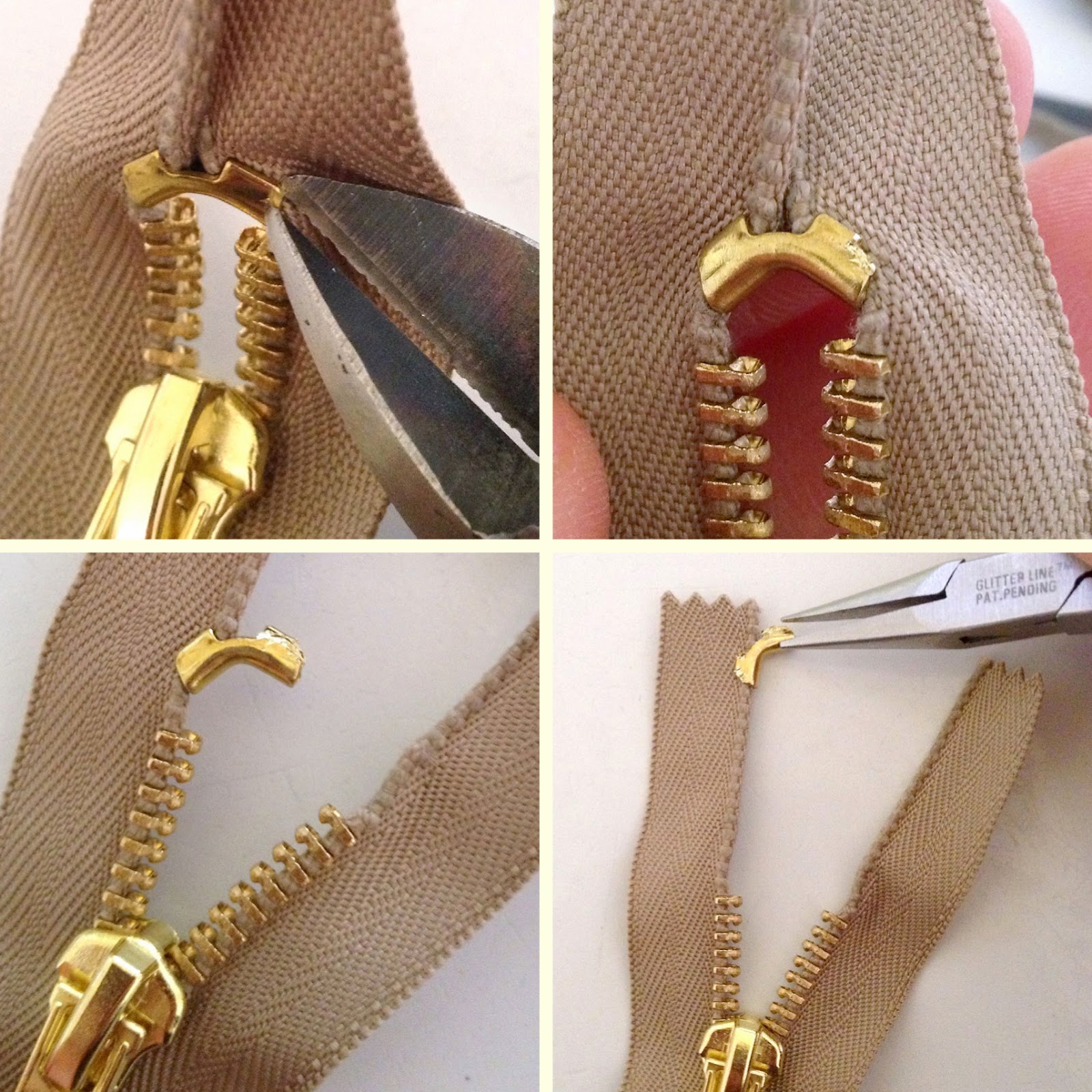
The first step is to remove the stoppers from both ends.

They are clamped down pretty darn tight (which I guess is a good thing) so this was harder than I expected it to be, but it just takes a little elbow grease and patience.

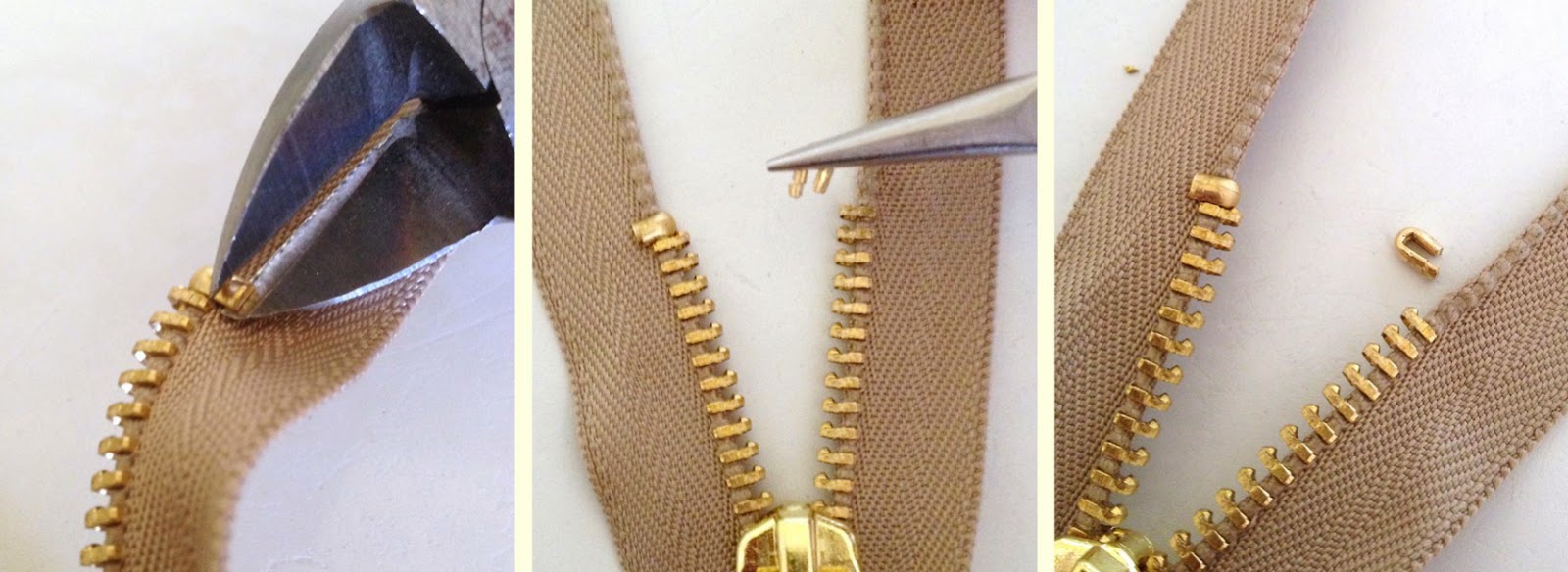
Start by carefully wedging the tip of your cutters under one side of the metal stopper and clipping off little bits of metal at a time. Be careful not to snag or cut the fabric tape.

Keep snipping away until you loosen the clamp enough to pull the stopper from the tape. Once it is free on one side, you should be able to slide it up and off the other side. If it is too tight, repeat the same process of clipping the metal away until it’s free.

The stoppers on the other end are thicker, but are also easier to pry off. First wedge the tip of your cutters underneath and try snipping. If the metal is too thick for your cutters, a bit of wiggling and prying should loosen the clamp enough to be able to pull it from the tape.

Repeat on the other side.

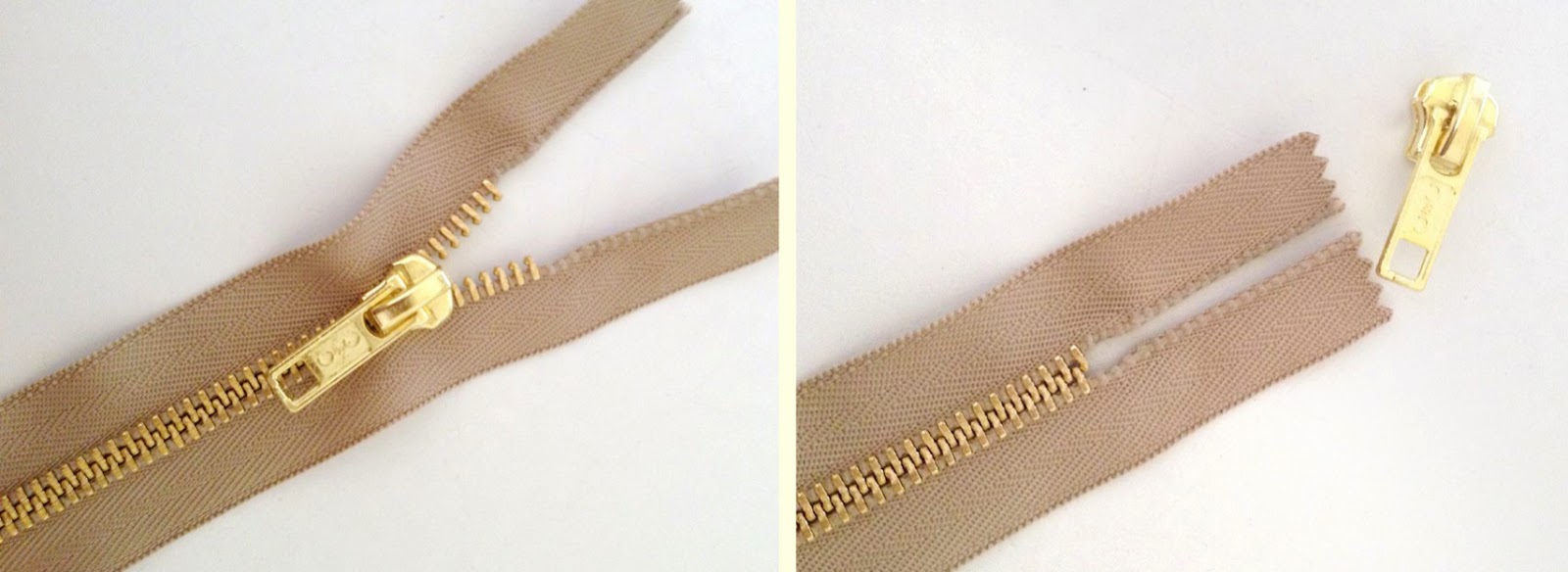
Once the stoppers are removed, move the sliders toward opposite ends so the zipper is closed and pull one slider off as shown above. It doesn’t matter which one.

The opposite end of your zipper will still have the other slider attached. Keep it on and pull it down to open the zipper a bit.

You will now put the loose slider you removed onto this end (toward the slider still on the zipper) by inserting the ends of the fabric tape into the channels of the slider and pulling it down until it catches the teeth, making sure they are lined up.

And Voila! Both your sliders are back on and your zipper now opens from the center.

Depending on your use for the zipper, this may be your final step, but be aware that the sliders are free to come off either end. If you are not sewing your ends into your project or if you have large gaps, you’ll want to make a tack stitch at the ends of the teeth or sew a piece of fabric onto the tape ends.

In the case of the cargo duffle that I’m making, one huge bonus of this modification is that I can take my zipper apart and sew the two sides on independently without having to maneuver around the sliders or deal with the bulk. Go ahead, pump your fist in the air and yell awesome!

If you do this, I recommend marking the ends of your tapes so you can put them back together properly. Technically, the teeth will go back together either way and there is no top, bottom, front or back with this specific zipper, but the length of the fabric tape is different on the two ends so they will be uneven if not matched up the same.

Once you’re done sewing, you just slip your sliders back on either end toward the middle and huzzah! Magic.

I hope you find this tutorial helpful! If you have any questions, just leave a comment below and I will do my best to answer them.

Thanks for visiting and happy sewing!

{UPDATE}

Since writing this post I have finished my first cargo duffle, hooray!

I certainly hit a few hiccups along the way and learned some important things to change and modify on the next one, such as adding zipper tabs on the sides, reinforcing the handles and using sturdier interfacing, but for my first bag project EVER I’m so thrilled with the results! I’m almost finished with my second duffle so will share more then.

p.s. I’m lillyellasworld on instagram if you’d like to follow and see my progress!


{Fabrics used: Main body, bottom accent and pocket flaps are Tim Holtz Eclectic Elements – Melange and Ticking Stripe. Pockets and handle accent are Robert Kaufman Quilters Linen in taupe}

Crafting: Fabric Rosettes

I’ve been doing a lot of cooking and not as much Crafting here lately, but I’m back on track and have a fun little project for you that satisfies my love of both accessories and fabric. It’s also perfect for making Valentine’s Day gifts for your friends and family or just for yourself! Today’s tutorial shows you how to make fabric rosettes which can be used on brooches, hair clips, necklaces, home decor projects and more.
What you’ll need:
fabric
felt
cardstock
pins
scissors
iron
craft glue (I use E9000)
pin backs, hair clips, bobby pins etc
buttons, beads, misc embellishments (optional)

Start with a strip of fabric 1″ by about 20″ – 25″. (I cut a 1″ strip the height of my fabric, then cut it in half. Many fabrics are 44″ so you end up with a 22″ strip, but some do vary which is ok.) You’ll need one strip of fabric per rosette.
Fold the strip in half and press with an iron.

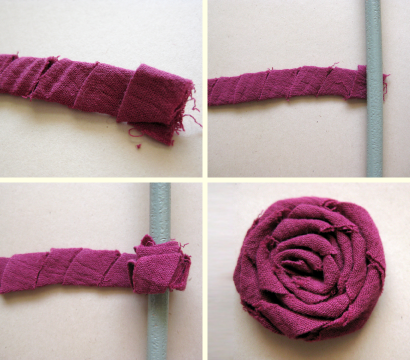
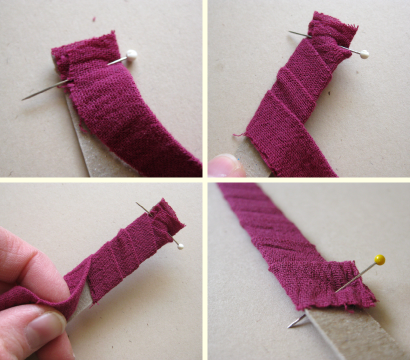
Cut a piece of cardstock (or cardboard) 1/2″ x 11″ (or the height of your stock). Pin the folded fabric strip to the cardstock and begin wrapping it around on an angle, not too tight. Secure the other end with a pin and press with the iron.
Once completely cooled, slide the cardstock out, keeping the wrapping as is. Fix any spots as necessary and press again with the iron.
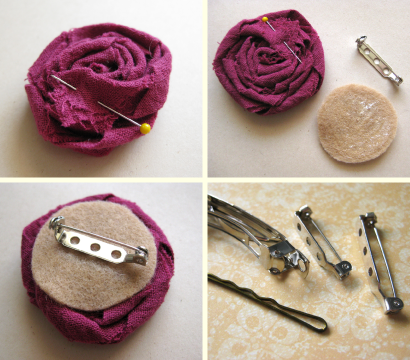
To form the rosette, roll the strip around a pencil starting at one end. Once rolled, slide the pencil out and begin to shape the rosette by spreading it out a bit and twisting the center with your fingers if needed. Secure the loose end on the back with a pin and lightly press again with the iron to flatten it a bit.
Depending on what you will be doing with your rosette, you can either stitch it together or you can glue it to a piece of felt (remove the pin before glueing). Ideally you’ll want to use a piece of felt that is close in color to your fabric but I just used what I had on hand.
You can then glue or stitch a pinback, bobby pin or hair clip to your rosette or sew it onto a shirt, bag, etc!
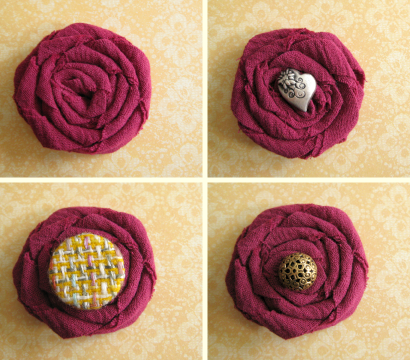
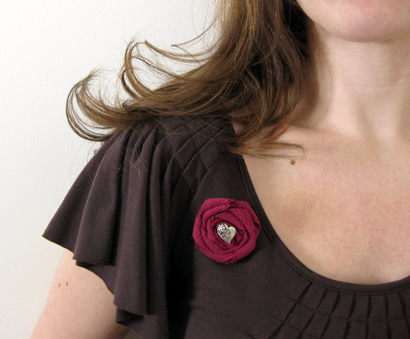
While I love the look of the simple rosettes by themselves, you can also embellish the center with buttons or beads which can be glued or stitched into place.


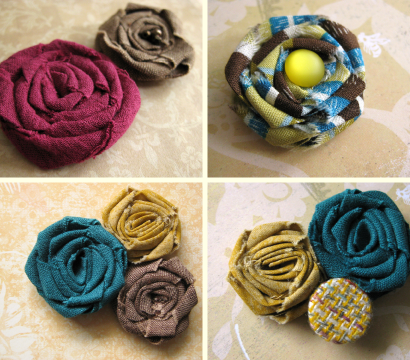
You can create rosettes in different sizes by using a longer or shorter piece of fabric or wrapping them tighter or more loosely. You will also find the type of fabric you use will affect the size of the finished rosette. Above can see how different embellishments really change the look of the finished piece.

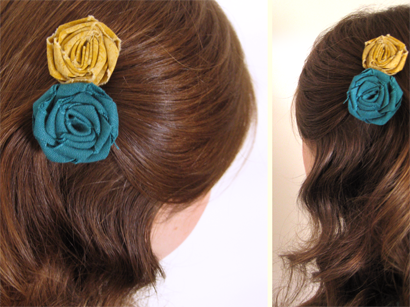
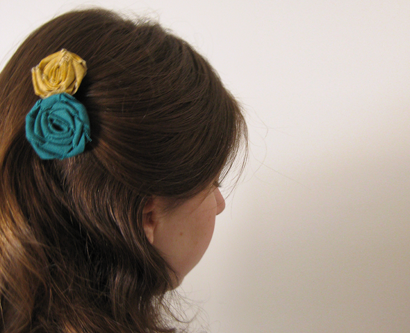
If using more than one rosette on a hair clip, brooch or necklace, glue them to a piece of felt and trim the excess felt once dry (shown a few photos up). You can then embellish and glue to a hair clip or add ribbon or chain for a necklace.
These would also be darling stitched right onto a tank top strap, across the top of a tshirt or onto one side of a cardigan. Oh, the possibilities!

A variety of materials, colors and textures creates a nice grouping and you can also add other elements, such as buttons or charms, to create a unique cluster or fill any gaps between rosettes with beads, pearls or scraps of trim and lace. Just have fun and experiment! And if you do, I’d love to hear about it. Happy crafting!

Crafting: Ruffle Necklaces

I’ve been swooning over the Candace Ang ruffle necklaces I’ve seen in magazines, but since I don’t have $200 to drop (and you probably don’t either), today’s project is an easy way to make one for yourself! It’s fast, you don’t need much and the results are just beautiful.
I used silk fabrics for this project but you could use any fabric that is thin enough to ruffle easily. Once you choose a fabric, you’ll need to pick a chain. You can use a chain you already have, deconstruct a piece of vintage jewelry or you can buy lengths of chain from your local craft store, in which case you will also need a clasp and some jump rings.

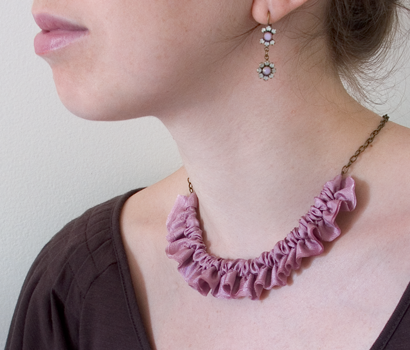
You will start by cutting a strip of fabric and the size will be dependent on the chain you are using, how many ruffles you want and how big you want them. For the pink necklace, I used a smaller chain and wanted shorter ‘tails’, so I cut the fabric to 2″. For the patterned silk shown above, I chose a chunkier chain so cut that piece to 2.5″. The fabric was in half yard pieces so I left the length as it was at about 18″.
Once cut, you can seal the edges of the fabric with Fray Block, Fray Check or another similar product, or heat seal them, if desired. I left the pink edges untreated because I don’t mind a little fray!
Fold the fabric strip in half and pin in place.
Next you will sew a sleeve for the chain. Be sure to make it large enough for the chain to fit through will a little extra room. When sewing, leave about 6″ of thread at the beginning and end and do not backstitch.
To create the ruffles, pull on the back thread (the bobbin thread) while scrunching up the fabric. It takes a little work to get the entire length ruffled but it will happen! I scrunched the fabric down to about a 7″ length. Knot the ends of the strings and trim them flush.
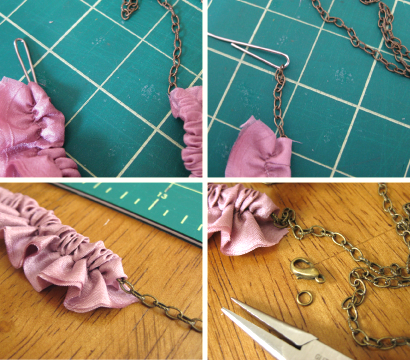
Next you will feed your chain through the pocket. You can use a safety pin or bend a paper clip to help feed the chain and it works best to have a rounded edge at the front so it slips through the fabric easier. If you are using a vintage or existing chain, you may need to remove the clasp or closure from one end to fit it through.
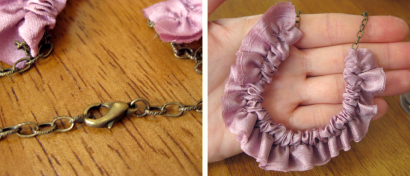
Once the chain is through you can attach (or reattach) your clasp. You can find clasps and jump rings in different metal finishes at most craft stores and you just need one or two pairs of needle nose pliers. You then have your finished necklace! 
You can easily modify this design by using different sized fabric strips and different styles and sizes of chains, the possibilities are endless! Use luxurious silks and satins for a fancier look or try springy lightweight cotton prints for a more casual piece. You can also sew on embellishments such as pearls, bead, rhinestones or fabric flowers.

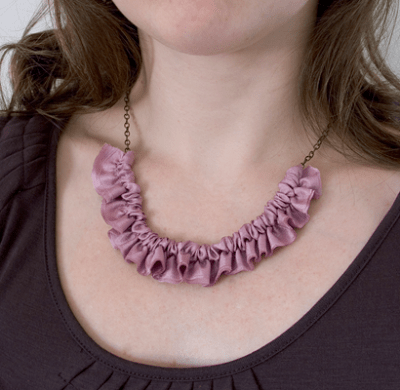
You could wear this necklace with a cocktail dress for a special occasion or with your favorite tshirt and jeans. It looks great worn as a choker like in the very top photo and also looks nice worn longer with a scoop neck shirt or off the shoulder top.
I have a couple more of these in different styles and sizes started that I did not have time to finish, but I will post some photos as soon as they are done. Maybe I’ll even give one or two away! I’d love to hear if you try your hand at this project, I hope you enjoy it!